

Cross-posted with Garden City Gossip
EVANS, Ga. - Columbia County officials projected $12.1 billion in net public revenue from Google’s planned data center development. The 35-year forecast relies in part on investment Google has not committed to make, uses project assumptions supplied by the Economic Development Authority of Columbia County (EDACC), and was prepared by a consultant that says it did not independently verify those assumptions.
The financial arrangement also includes something county officials had previously said the project would not receive: a property-tax incentive.
“We are not going to give incentive, tax incentives to these folks to come in where the project is there to offset property taxes,” Commission Chairman Doug Duncan said during a July 2025 appearance on The Austin Rhodes Show. “End of story.”
The Memorandum of Understanding approved by EDACC on Aug. 26 includes a 25-year leasehold valuation schedule for each qualifying data center building. The schedule reduces its taxable leasehold value for the first 24 years.
That provision was not mentioned in Columbia County’s Aug. 26 news release. The release emphasized the project’s potential to generate billions of dollars in revenue and provide property-tax relief to homeowners. A copy of the MOU was not released with the announcement.
The Columbia County Observer requested the MOU through the Georgia Open Records Act on the evening of Sept. 4 and received it Sept. 8. The copy provided through the request had not been signed by Google or Kinetic Infrastructure Solutions, the company identified in the agreement. County officials later confirmed that the MOU is awaiting official approval from Google.
County Manager Scott Johnson was meanwhile publicly discussing revenue projections from the project, but the Fiscal Impact Analysis underlying those projections had not been provided. The Observer sought those records separately. EDACC provided the Fiscal Impact Analysis on Monday, Sept. 21.
What Google has committed to
The Fiscal Impact Analysis projects $12.1 billion in net revenue for Columbia County and the Columbia County School District over 35 years.
Google has committed to the project’s first $17 billion phase over the initial three years of the project. EDACC’s disclaimer accompanying the report says subsequent phases are “proposed, not confirmed.” The analysis nevertheless includes those future phases in its 35-year projections for planning purposes.
Economic Impact Group prepared the analysis using project characteristics supplied by EDACC, including capital investment, employment, wages, construction phasing and incentive terms. The firm said it did not audit, verify or independently confirm that information and made no representation about its “accuracy, completeness, validity, feasibility, or reasonableness.”
The report discloses some of the assumptions used in the model. The MOU provides others. Neither document contains all of the underlying information needed to independently reproduce the projections. The fiscal analysis, for example, provides annual property-tax projections but does not show the projected fair-market values of the buildings and equipment used to calculate them.
After receiving the analysis, the Columbia County Observer filed an Open Records Request on Sept. 21 seeking the inputs, assumptions and data supplied to Economic Impact Group, records identifying the sources of those inputs, and the contract or scope of work for the analysis.
Those records have not been provided to date.
$45 million in fees, plus property taxes
The project would generate local government revenue in two distinct ways. The first is property taxes, which are reduced during the incentive period through the leasehold valuation schedule.
The second is an annual Authority fee. The MOU requires at least $45 million annually during the first seven years.
Johnson explained during a September appearance on The Austin Rhodes Show that $5 million would remain with EDACC and $40 million would go to Columbia County. He said the additional payment was negotiated because county property-tax revenue from the project would initially fall short of the amount officials wanted for homestead property-tax relief.
The fiscal analysis projects approximately $48.9 million in Columbia County property taxes in Year 1 and $43.9 million in incentives and support, a difference of about $4.9 million. The county would also receive the separate $40 million annual payment Johnson described.
The school district does not share in that $40 million payment. For the same year, the analysis projects approximately $111 million in school property taxes and $99.8 million in incentives and support, a difference of about $11.2 million. It also projects about $4 million in school sales-tax revenue. For scale, the Columbia County School District’s FY2027 General Fund budget is approximately $435 million.
How the tax incentive works
The incentive relies on a bond-for-title arrangement.
Under the MOU, Kinetic would convey the property and improvements associated with the project to the Development Authority, which would lease them back to the company. The Columbia County Board of Tax Assessors determines the fair-market value, while the company’s leasehold interest is taxed according to a predetermined schedule.
Each qualifying building gets its own 25-year schedule. For the first five years, the leasehold factor is 10 percent. It increases over time until reaching 100 percent in Year 25. The tax reduction therefore applies for the first 24 years.
Buildings completed later start their own schedules. The Fiscal Impact Analysis models 16 buildings coming online over time, extending the overall abatement period through Year 33.
The schedule dates to 2014
The leasehold valuation system used for the Google project was not created for Google. It dates to 2014.
Minutes from the Feb. 11, 2014, meeting of the Columbia County Board of Tax Assessors show Development Authority legal counsel Douglas D. Batchelor, Columbia County Attorney Chris Driver and then-Development Authority Executive Director Robbie Bennett presenting what the minutes called “Lease Factor Rates Policies.”
The board approved the policies unanimously.
The accompanying “Columbia County Leasehold Valuation Guidelines” established a framework for economic development projects using taxable abatement bonds and leaseback agreements. One exhibit created a separate set of leasehold schedules specifically for “Technology and Data Centers.”
The guidelines did not approve an incentive for a particular project. Individual projects would still come before the Development Authority for consideration.
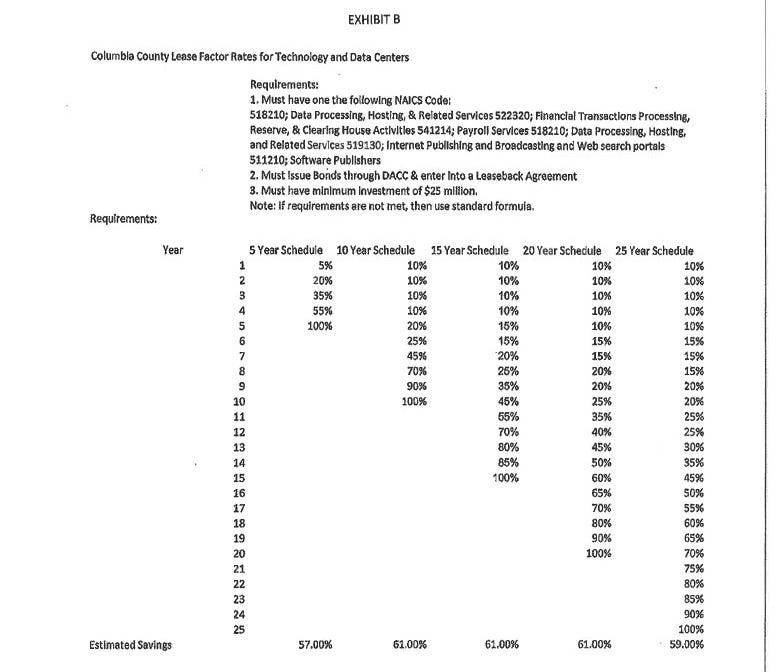
Exhibit B from the 2014 Columbia County Leasehold Valuation Guidelines established leasehold valuation schedules specifically for technology and data center projects.
Data centers could qualify for schedules lasting five, 10, 15, 20 or 25 years. The 25-year schedule begins with a 10 percent leasehold factor for the first five years and gradually increases to 100 percent in Year 25.
That is the same basic schedule incorporated into the current MOU.
Doug Duncan served as vice chairman of the Development Authority in 2013 and chairman in 2014. The Feb. 11, 2014, Board of Tax Assessors meeting minutes do not list him among those attending.
The 2026 Fiscal Impact Analysis says the “pre-approved data center leasehold valuation structure” was approved by the Columbia County Board of Commissioners on Feb. 4, 2014. A review of the Feb. 4 Commission meeting minutes found no reference to the Leasehold Valuation Guidelines, the data center leasehold schedule or a vote approving either. Development Authority records show the proposed lease-factor rates had been forwarded to the County Administrator and County Commission in 2013, so the Commission may have considered the policy earlier.
Behind the $12.1 billion projection
Over 35 years, the fiscal analysis projects $4.4 billion in net revenue for Columbia County and $7.7 billion for the school district after incentives and estimated public costs. The $12.1 billion projection extends well beyond Google’s committed $17 billion first phase. It incorporates additional development that EDACC describes as proposed but not confirmed.
The analysis provides annual revenue projections extending 35 years, but the underlying project inputs used to produce those figures have not been provided to the Columbia County Observer. Economic Impact Group states that those inputs were supplied by EDACC and were not independently verified by the firm.
The Observer’s Sept. 21 Open Records Request seeks those inputs, their sources and the scope of work for the analysis.
Until those records are provided, the public has these projections. However, it does not have the underlying data needed to independently reproduce or verify them.
Source Documents:
