

Board Members Present: Chairman David Dekle, D1 Philip Kent, D2 Kristi Baker, D3 Judy Teasley, D4 Katie Allen
Call To Order: 5:30pm
Special Recognitions
Georgia High School Association
GHSA 5A Golf State Champions
Hamilton Coleman
Charles Elsken
Brighton Glodava
Cooper Hawkins
Andrew Higgins
Tabb Hinson
Qasim Khan
Kipp Madison
Grant Murray
Tyler Newsome
Sam Rogers
Jacob Weaver
Bennett Wiggins
GHSA 5A Girls Golf State Championship, 3rd Place, Greenbrier High School
Gabriella Burkett
Jaclyn Cressend
Shane Daly
Khera H Khera
Adyson Lukich
Madelyn Silarek
Avery Simpson
Benton Vineyard
GHSA 5A Girls Soccer State Champions, Greenbrier High School
Peyton Anderson
Analaura Boone
Arianna Boone
Darcy Bridwll
Sophie Campanaro
Mackenzie Canady
Nora Dye
Belle Gantt
Krista Gillies
Molly Grover
Talashia Harris
Madelyn Heckathorn
Addison Jernigan
Maura Jobes
Murphy Larkin
Kate McDonald
Kinley Mitchell
Sadie Oldham
Mamie Cate Pangle
Stephanie Schroeder
Aaliyah Silver
AdelinaStrupp
Aubrey Strupp
Alayna Tamez
Sarah Wahl
Sophie Witt
GHSA 5A Girls Tennis State Runner-Up, Lakeside High School
Victoria Bishop
Emily Bull
Elise Clemente
Charley Fair
Marlea Griffis
Genevieve Handel
Madeline Jackson
Hannah Liebel
Georgia Manolakis
Savanna Mills
Manasvi Patel
Siya Patel
Katherine Peterson
Lauren Smith
Connor Trammell
National Grant for Summer Fellowship
Crystal McDowell, Greenbrier High School
Special Recommendation
Director of Talent Development, HR: Dr. Kenneth L Johnson
Approval of Consent Items: Yay 5, No 0
7/21/2026 Regular Session Meeting Minutes
Fundraisers
Employee Travel
Program/Camp/Employe Participation Requests
Lease/Use of Facilities
Board Policies: Approval of items b-e: Yay 5, No 0
a. Board Policy EBB, Safety
b. Board Policy GARJ, Employee Retirement
c. Board Policy IH, Student Achievement
d. Board Policy JB, Student Attendance
e. Board Policy KG, Use of School Facilities
Dr. Flynt pulled item “a” off the list because staff still has some changes they want to make. Recommended approval of policies b-e.
Allen: What was the reason for the changes in item “b” Board Policy GARJ?
Flynt: This was changing the wording from TRS. This reflects some legislative changes as well. Some items were pulled off and moved to procedure. The law was effective 7/1/2026.
Adoption of the 2026 Tax Digest Millage Rate to the rollback rate of 14.997. Approval Yay 5, No 0
Human Resources Staffing Update, Tony Wright
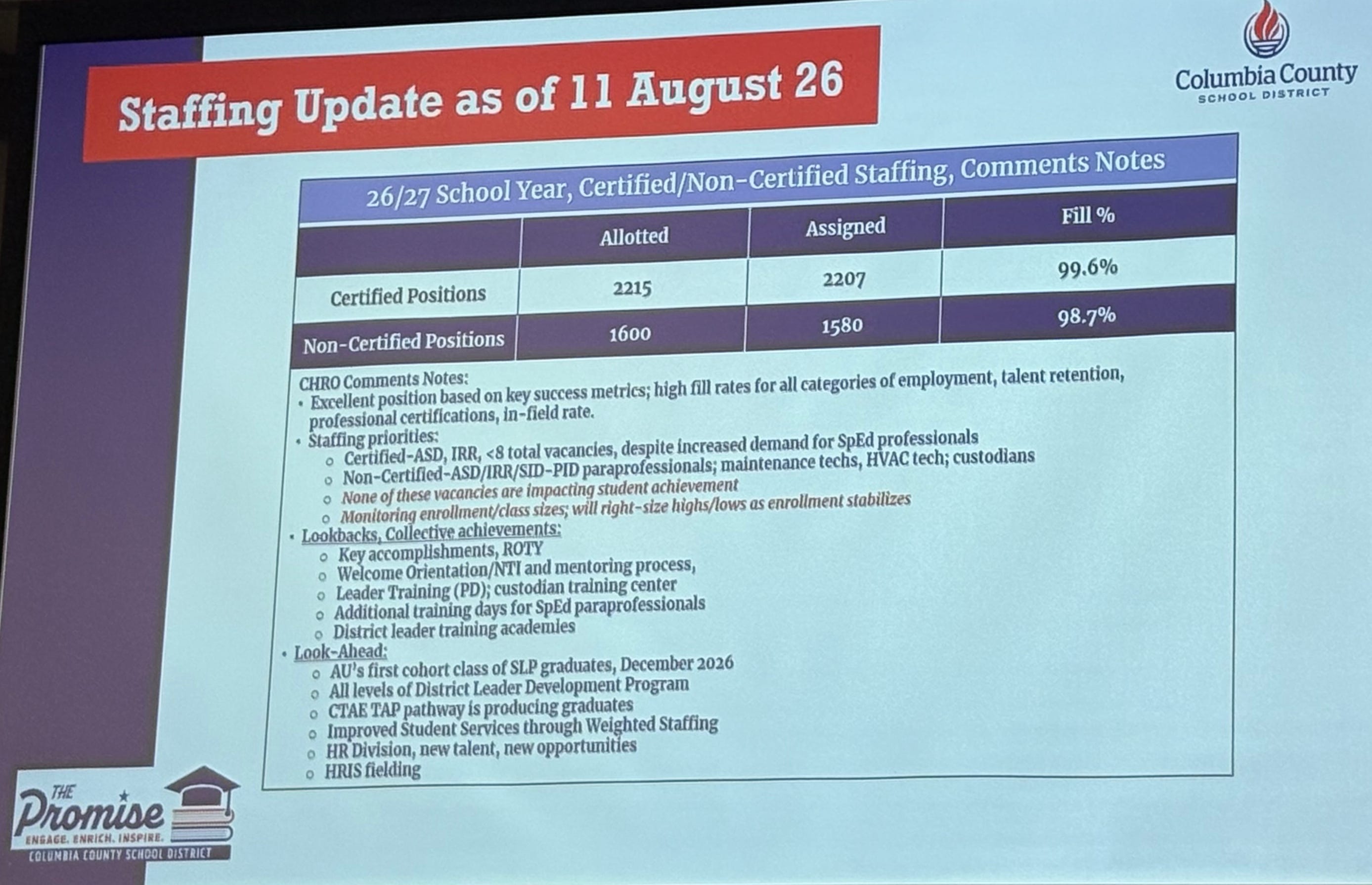
2,207 of 2,215 certified positions filled, a 99.6% fill rate.
Fewer than 10 certified vacancies, primarily in ASD and interrelated special education positions.
Demand for specialized positions increased by about 14%, or 42 additional positions, over last school year.
Non-certified positions: 1,580 of 1,600 positions are filled, a 98.7% fill rate.
Current recruiting priorities: 8 special ed para vacancies and 11 combined maintenance technician, HVAC technician and custodial vacancies.
Current vacancies not affecting student achievement and coverage plans are in place.
New teacher orientation and mentoring program, custodial training center, additional training days for special ed paras, district leadership academies, Augusta University’s first speech-language pathology cohort graduating December, the CTAE teacher apprenticeship pathway, and continued work on weighted staffing and a new HR information system.
Discussion
Allen: Asked about para staffing and referenced prior information suggesting the district lost about 80/ year.
Wright: Said losing 80 paraprofessionals annually would be a significant problem and estimated turnover among special education paras at under 20% per year. Said the district has roughly 78–90 ASD-specific paraprofessional positions and another 50–60 interrelated paraprofessional positions.
Proposed School Calendar Options for 2027-2028, Penny Jackson
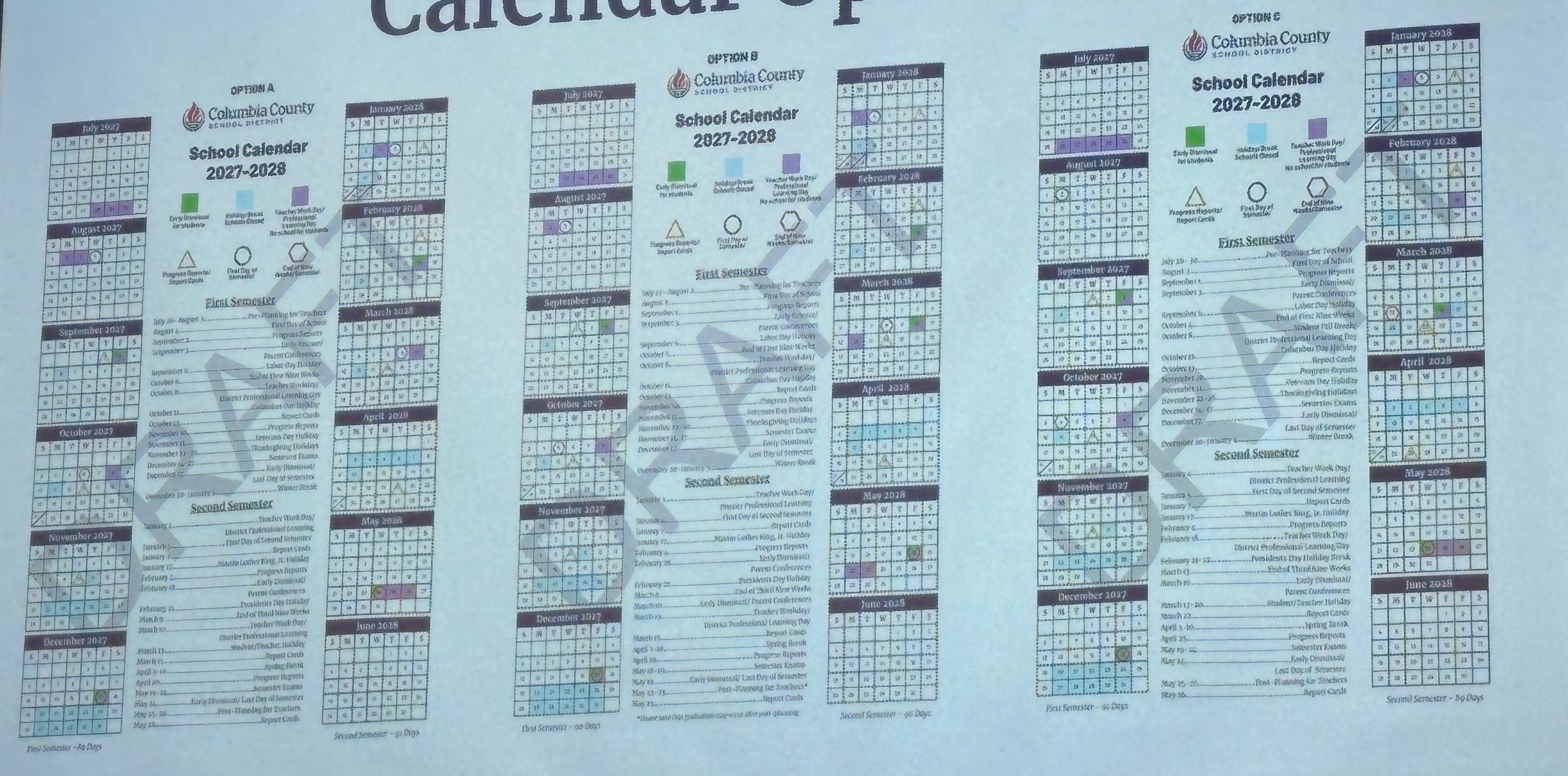
School Calendar Advisory Team: parents, teachers, administrators and district personnel, began in May.
Each option has180 instructional days and incorporates required teacher workdays/professional development days, holidays, seasonal breaks and at least one early-release day per semester for parent conferences.
The district continues its practice of ending first semester before winter break and second semester before Memorial Day.
Calendar survey opens Aug. 12 and closes Aug. 21. District employees will receive the survey by email, and a link will be posted on the district website for public feedback.
Survey results and the preferred calendar option will be presented at the next board meeting for approval.
Graduation dates/venue remain TBD, which could affect the end-of-year schedule. One option would end school earlier but could require staff to return after post-planning for graduation.
Advanced Placement Update for 2026, Dr. Campbell
30+ AP courses across its five high schools.
Since 2021, the number of AP exams administered has increased 59%, from 3,298 to 5,242.
District’s AP exam pass rate increased from 55% to 81%, the first time the district has exceeded an 80% pass rate.
Newer AP offerings include AP Business with Personal Finance, AP Cybersecurity and AP Cyber Networking.
Evans High School: Highest 3-year increase in percentage of AP exams earning a 3 or higher; increased 13 percentage points to 83%.
Harlem High School: Highest 3-year increase in total AP exams; increased 27%.
Greenbrier High School: Highest percentage of AP exams earning a 3 or higher (90%) and highest AP participation, with 40% of students taking at least one AP exam.
Grovetown High School: Highest 1-year increase in percentage of AP exams earning a 3 or higher; increased 6 percentage points to 82%.
Lakeside High School: Highest one-year increase in total AP exams; increased 20% to 1,518 exams.
51% increase in dual-enrollment participation over the past 3 years, while AP participation has also continued to grow.
AP English and AP U.S. History are most popular AP courses. AP Psychology and AP Government more approachable entry points for students who may be hesitant about AP.
Uses PSAT 8/9 results and College Board’s AP Potential reports to identify students who may be capable of succeeding in AP courses.
Junior Achievement Dream Accelerator, Dr. Campbell
Dr. Campbell:
District developing framework to help every student graduate with a defined post-graduation pathway.
Framework supports Georgia’s Top State for Talent Act (HB 192). Includes career-interest inventories, aptitude assessments and individual college and career plans beginning in middle school.
Brand pathway initiative “What is Your E Plan?” 3 broad post-graduation options: Enroll, Employ or Enlist.
Students begin developing an Individual College and Career Plan (ICCP) in sixth grade, with parents able to access plan through parent portal. In HS, district would refer to the plan as the student’s E Plan.
Already uses Junior Achievement programming, career-interest surveys, YouScience aptitude assessments, pathway fairs, the College and Career Expo and work-based learning opportunities.
Proposed Dream Accelerator would be incorporated in 8th and 10th grades to provide immersive career exploration experience. Help students develop and revise plans.
Students receive report with career interests and goals, shared with teachers and counselors and incorporated into ongoing college/career plan.
Dream Accelerator installed in approximately 3,200 square feet of currently unused space adjacent to the existing JA Discovery Center.
District would contribute up to $1.3 million from the 2026–27 curriculum and instruction budget. Junior Achievement funding partners would contribute approximately $700,000, for an estimated total project cost of $2 million.
No district wide textbook adoption scheduled this year, leaving curriculum and instruction funding available for project.
Program serve approximately 5,000 8th and 10th grade students each year.
John Hancock – Junior Achievement of Georgia
Junior Achievement’s focus career exploration, entrepreneurship, financial literacy and workforce readiness, with an emphasis on experiential learning.
Dream Accelerator complements existing programs at Discovery Center.
Unlike many JA programs designed for a single grade level, Dream Accelerator can be used at multiple grade levels, allowing students to revisit career planning as they progress through school.
Program includes classroom prep followed by an approximately two-hour interactive experience.
Students move through stations focused on personal strengths, career exploration, lifestyle costs, entrepreneurship, visualization and SMART goals.
Program intended to help students explore possibilities rather than assign them to a particular career path.
JA responsible for ongoing technology support, with program content generally refreshed on a 3-year cycle.
Discussion
Allen: Raised concerns about operations, finances and potential conflicts. Noted previous difficulty recruiting volunteers for the existing JA Discovery Center and questioned adding another program requiring additional volunteers.
Hancock: Said 6 volunteers would be ideal, but program could operate with approximately 3 because interactive individual stations.
Allen: Questioned spending up to $1.3 million after the district transferred $20 million from the general fund to the building program, and adopted a budget using approximately $40 million in general fund balance. Said didn’t believe this was appropriate year for the expenditure. Raised concerns about Dr. Flynt serving on the Junior Achievement board while district considers another major investment with JA. Asked when he joined the board.
Hancock: Said Flynt joined the JA board in September 2025.
Allen: Asked for participation data from the existing Discovery Center, costs and volunteer requirements from other Dream Accelerator programs, and evidence of measurable student outcomes from both Dream Accelerator and the district’s existing JA programs.
Kent: Said he supports concept but shared Allen’s financial concerns. Said board’s aggressive building program limits its ability to take on additional spending and that he could not support project this year.
Dekle: Supported the expenditure, arguing that $1.3 million in curriculum and instruction funding would serve approximately 5,000 students per year. Compared the cost with textbook adoptions of $2–$4 million and said the program could serve approximately 35,000 students over 7 years.
Allen: Asked if district could wait a month to obtain additional information before making a decision.
Teasley: Said students who have a goal are more likely to graduate, even if they ultimately change goal. Pointed to the district’s approximately 92–93% graduation rate.
Allen: Said evidence that Dream Accelerator could produce even a 2–3% increase in graduation rates would strengthen the case for the program, but reiterated that she wanted supporting data before approving it.
Allen: Moved to table the proposal until the board received additional information. Yay 2 (Allen & Kent), No 3.
Baker: Asked what information was available from Clayton County and how widely Dream Accelerator had been implemented.
Hancock: Said Dream Accelerator originated with JA in Denver and had been replicated three times. Clayton County’s program opened in February, so long-term data are not yet available. Said JA has some info on teacher satisfaction, student experience and alignment with school strategies, but isolating the program’s effect on long-term student outcomes is difficult.
Allen: Asked whether JA had data showing how often students ultimately enter the careers they identified through Dream Accelerator.
Hancock: Said that data do not yet exist because the program is relatively new and reiterated that the goal is career exploration rather than assigning students to a specific career.
Allen: Asked how Dream Accelerator fundamentally differs from the career-interest and aptitude surveys students already take.
Campbell: Said the primary difference is the interactive experience. Students connect interests with possible careers, examine salaries and lifestyle costs, set goals and take those results back to teachers and counselors for continued planning.
Allen: Asked whether the program accounts for AI’s potential impact on careers over the next five to ten years.
Hancock: Said he did not have a specific answer but agreed it was an important consideration and said JA could examine it further.
Kent: Asked whether the district’s $1.3 million share was a realistic estimate and whether the final cost could be lower.
Hancock: Said the approximately $2 million total project cost was likely accurate within about 5–8%. He said JA would also seek philanthropic contributions, which could proportionally reduce the amount paid by both JA and the district.
Dekle: I make a motion that we approve up to $1.3 million out of the curriculum instruction budget to partner with Junior Achievement to develop a Dream Accelerator in Columbia County. Yay 3, No 2 (Allen and Kent)
Contract for Services CSRA RESA: Yay 5, No 0
Basic Membership $106,324
Vision Education $ 30,754
Orientation & Mobility $ 41,672
Total Contract $178,750
Superintendent Reports
Progress Reports, September 3
Early Dismissal/Parent Conferences, September 4
Labor Day Holiday, September 7
Columbia County School District Retirement Reception, September 16
Columbia County Teacher of the Year Celebration, October 1
End of First Nine Weeks, October 6
Student Fall Break/District Professional Learning Day, October 9
Columbus Day Holiday, October 12
Report Cards, October 14
Public Participation:
None
Executive Session: Yay 5, No 0
Affidavit: Yay 5, No 0
Personnel Sheet: Yay 5, No 0
Executive Session Procedures:
Motion to table executive session procedures: Yay 4, No 1 (Allen)
Adjourn: 8:25 pm
Thank you for your work!