

(Board Members: Chairman Dekle, Vice Chair/D1 Philip Kent, D2 Kristi Baker, D3 Judy Teasley, D4 Katie Allen)
Call To Order: 5:30 pm
Invocation: Tabernacle Baptist Church Executive Minister of Operations, Reverend Michael Woods
Pledge of Allegiance: Baker Places Elementary School 4-H Presidents
Approval of Agenda: Yay 4, Opposed 1 (Katie Allen)
Before vote, Allen made the following motion but there was no second: “I make a motion to amend the agenda to remove item nine, due to the fact that the resolution we will be discussing tonight was sent today at 2:44 p.m. It is not the resolution requesting local legislation that was intended to be discussed.”
Dekle: That's on the agenda for discussion, and if a resolution is presented, it all falls into that category.
Special Recognitions
Georgia Certified Teacher Induction Program Award
Dr. Carrie Ann Cushman, Director of Professional Learning
Tony Wright, Chief Human Resources Officer
Georgia Department of Education John Hancock Award Schools
Proficiency Award: At least 90% of students can write their names in cursive.
Blue Ridge Elementary – Principal Jessica Williams
Brookwood Elementary – Principal Dr. Leslie Dial
Grovetown Elementary – Principal LaToya Jackson-Barnett
North Columbia Elementary – Principal Tonya Gambrell
North Harlem Elementary – Principal Melissa Culpepper
Parkway Elementary – Principal Stephanie Winter
Riverside Elementary – Principal Lynn Gardner
Stallings Island Middle – Principal Vicki Tarleton
Distinction Award: At least 90% of students can write their names and the preamble to the U.S. Constitution in cursive.
Euchee Creek Elementary – Principal Katy Yeargain
Greenbrier Elementary – Principal Ashlee Odom
River Ridge Elementary – Principal Michelle Miller
Stevens Creek Elementary – Principal Kelli Robertson
Georgia Department of Education Title 1 Distinguished and Reward Schools
Title I Distinguished Schools:
Blue Ridge Elementary – Principal Jessica Williams
Brookwood Elementary – Principal Dr. Leslie Dial
Martinez Elementary – Principal Dr. Whitney Smith
Westmont Elementary – Principal Angie Young
Title I Reward School:
Euchee Creek Elementary – Principal Katy Yeargain
Georgia Thespian Honor Society State Officer Recipients
Eli Bisel – Harlem High School
Abigail Alwine – Grovetown High School
Board Comments and Acknowledgments":
Board members Kristi Baker, Judy Teasley, Philip Kent, and Katie Allen congratulated award recipients and thanked students, teachers, administrators, and families for their contributions to the district. Baker shared an anecdote about encountering Columbia County teachers at Disney World. Teasley praised the cursive writing awards and expressed surprise that the district had not previously earned teacher induction certification.
Approval of Consent Items: Yay 5, No 0
9/22/2026 Work Session Meeting Minutes
Fundraisers
Employee Travel
Program/Camp/Employee Participation Requests
Lease/Use of Facilities
Unified District Literacy Pan, LeAnne Greg. Approve: Yay 5, No 0
Developed in response to HB 1193 and state literacy requirements.
K–12 plan formalizes many literacy initiatives already in place.
Focus on reading, writing, speaking, listening, vocabulary, and critical thinking across all subjects.
K–3 progress measured through universal screeners; grades 3–12 through Georgia Milestones and reading readiness data.
Students needing additional help receive targeted interventions through MTSS.
Literacy Coaches
District plans to place a full-time literacy coach in every elementary school.
Currently recruiting and screening applicants.
Four elementary schools will begin implementation in January 2027.
Coaches will receive professional development throughout spring 2027.
Full implementation scheduled for August 2027.
Coaches will support teachers with instructional strategies, modeling, and planning.
Board Discussion
Teasley: Asked how this differs from current practices.
Gregg: Many initiatives already in place, but previously no comprehensive written plan.
Teasley: Is state paying for all these positions?
Flynt: State pays a portion through QBE. District will have additional expenses. Already receiving state funding, which will remain in reserves until positions are filled.
Teasley: How were the 4 schools selected?
Gregg: Collaborative decision between associate superintendents and curriculum staff. Selected schools representing a range of literacy needs.
Kent: Elementary teachers have a lot on their plates, including ESL, gifted, and special ed students. Additional literacy coaches should help?
Gregg: Coaches will benefit both teachers and students.
Kent: Did the state provide guidance or did the district develop its own plan?
Gregg: HB 1193 established qualifications and job requirements for coaches. District developed its own literacy plan based on existing initiatives.
Resolution Requesting Local Legislation for Homestead Exemption in Anticipation of Data Center Revenue
(This portion is transcripted)
Flynt: Board members, we’re at the point in the meeting where the topic is a resolution requesting local legislation for homestead exemption in anticipation of data center revenue. As you’ll recall, the last couple of meetings we’ve had some very good discussion on this. I don’t think we’re in the place where we have a final version, but we did want to have a continued discussion. You’ve seen a couple of drafts. Thank you for your input. I don’t think we’ve hit the mark quite perfectly yet, but through your input, I think we’ll be able to get there.
I think at this time, the best next step is continued discussion as a board, which I’d be happy to participate in as well, and trying to get to that final resolution, which we would try to bring at the next meeting, assuming we get to that point.
Dekle: I’d just like to open the floor up for any questions or discussions regarding this matter, which is a work in process.
Kent: I’d actually like to make a motion to approve a resolution. Last meeting, we put forth what we wanted to have in a resolution. We voted unanimously to approve specific items, particularly involving how homesteaders would receive tax relief off data center revenue, and acknowledge the work that’s already been done to create pathways to achieve that goal.
I feel like we’re in a position to do it. We discussed it quite a bit last meeting. I’d rather not see it go to another meeting. We need to move things forward. There’s work that needs to be done. There’s a base resolution that the rest of the body up here has in front of them that is a very broad resolution that just shows our intent and what our intent is for these dollars. I think it’s important for the public to know what our intent is in this regard.
And so I make a motion that we actually do this general broad resolution, and it’s Columbia County Board of Education Resolution Expressing Its Intent to Pursue Property Tax Relief in Anticipation of Potential Additional Revenue Generated by Data Centers and Other Commercial Development.
Motion seconded.
Allen: One, the resolution that we requested as a board at the end of our previous meeting was not the resolution that was provided on Wednesday. It was significantly different. I had sent an email to Dr. Flynt explaining why it was different than the motion we approved, which was for a broad resolution.
Dr. Flynt, to your credit, I appreciate that you brought back another version. However, all that did take time. The resolution in front of us tonight was sent at 2:44 p.m., Mr. Kent. That was not enough time for me to thoroughly review it.
The resolution that was sent that essentially corrected the Wednesday one was sent Monday very quickly, considering by the time I reviewed it and was able to voice how it was entirely different from what we agreed, that was Sunday evening, very late. So again, a quick turnaround from Dr. Flynt on Monday to provide that resolution.
However, ultimately, my issues are procedural. One, the public knows that we intend to give taxpayer money back, and I want to preserve that because I’m seeing, problematically, in some of these resolutions and the legislation that was drafted and provided to us to be our legislation, I’m seeing loopholes so clear, and those need to be explored. Those need to be closed.
I don’t want a loophole that says we could give taxpayer money back to the citizens, but here’s all the ways we don’t have to. That is the last thing I want.
So I want us to make sure we take the time this needs, do it right, look through this resolution, which is the first step in this process, and come back in two weeks when we’ve had time to review Mr. Kent’s updated version, which may be fine.
But at the same time, this is so important. Also, procedurally, the item on the agenda that was published to the public 24 hours in advance of that meeting specifically states the title of the resolution that was provided to us on Wednesday, which means the item on the agenda for this meeting is not the same as the resolution that we are now being asked to approve.
So for the purposes of discussion, I can go into the legislation, but ultimately the resolution, just from the bit that I’ve read in the time since I arrived at this meeting and got to read through it at my desk here, I’m seeing potentially some areas where it allows for this other draft legislation, which, to my understanding, Dr. Flynt, that draft legislation that you provided on Wednesday is already at Legislative Council for review, and Gary Richardson is already working to some extent with us.
Flynt: We would do that with any adjustments or changes.
Allen: Right. So we’re pretty serious about this legislation, and I think there’s things in there that do not protect our intent to bring taxpayer money back to citizens.
So before we do a resolution that moves us in that direction, we need to take two weeks. Come back at the next meeting prepared to talk about this resolution that Mr. Kent has provided. Have it ensured that it matches the agenda item that the public was provided, so that we are doing things procedurally correctly, because it is a very dangerous precedent to put something on the agenda and then discuss and approve something entirely different during the agenda.
Dekle: I would just point out that we actually voted at the last meeting to entertain a resolution.
The substitute resolution, or the one presented by Mr. Kent, which actually, I think Superintendent Flynt sent something out last Wednesday asking for input. He didn’t receive anything from you, Ms. Allen, until Sunday night.
Then he put together, as you acknowledge, a more general resolution, and that came out on Monday. So that was in people’s hands on Monday, and Mr. Kent worked on some revisions that he proposes.
And so, you know, we don’t always have the advantage of all the time in the world that we would like. But I have had an opportunity to review this resolution. I think it comports with the spirit and intent of what we voted on at the last meeting. So there should be no surprises.
And as far as the draft legislation that we’re looking at, it’s a work in process, and we’re not ready to present that. Hopefully, whatever we arrive at, we’ll be able to reach a consensus so that we can move forward in a timely manner as the General Assembly session approaches.
Allen: Chairman Dekle, I would counter that. Yes, it came out Wednesday. Beginning Friday, all the way through Sunday, I spent, conservatively estimating, at least 10 hours researching.
You provided draft legislation and a legal resolution to go with it. That was very consequential for this county. It takes time to research legislation, see what other counties are doing, see what problems they may have had, look at potential legal consequences, look at ways things can be abused through language, look at ways that language leaves things open to interpretation.
It does take time. It took me 10 hours. I don’t know what time it took you, Chairman Dekle, or the fellow board members, but something like this should take time.
Which is why even a Wednesday to a Tuesday vote, to me, is very quick. But certainly a Sunday or a Monday or 2:44 p.m. to a final vote should take time.
Kent: We’re not planning to adopt—
Allen: That’s what’s on the agenda.
Dekle: This resolution does not adopt any specific request or specific legislation.
Kent: This is specifically what you actually agreed to and voted for in the last meeting that we had. So I think we’re honoring exactly what we said we wanted.
It’s different from what came out originally, but it was time for us to put it in a place where it all was in virtue of everything you agreed to in the last meeting.
So it makes sense for us to move forward with this, I believe, based on that, because we have to start somewhere.
The other items that you brought, specific to particular legislation and all the ramifications of that, those will be discussed. But you have to start with a resolution. You have to start somewhere. Otherwise, we just keep kicking the can.
And honestly, the superintendent and the administration, they have to do some work in order to create these pathways to accomplish what our intent is.
Unless you’re suggesting that you’re changing the intent for what the taxpayer dollars are going towards, which is homestead tax. Has that changed?
Allen: My intent is as documented in these minutes, which is develop a resolution on potential property tax relief from data center revenue should data center revenue become available. Board member Katie Allen seconded the motion, provided that the resolution would serve as a broad intent statement.
Okay, that could be in this resolution, but just one item in this resolution that’s very problematic is:
“Whereas the board recognizes the importance of providing quality public education while maintaining responsible fiscal management and minimizing the property tax burden on taxpayers to the extent reasonably practicable.”
That’s important. But when I pair that with the legislation that was presented by Dr. Flynt on Wednesday, there’s a clause in there that states that the board decides how much of that data center revenue is set aside to return back as homestead exemption credits.
And the board has the opportunity to transfer any additional funds that they don’t return to the public back to the general fund.
Kent: We’re not voting on that tonight.
Allen: No, but this opens the door, and I want, from the resolution step forward, that we close the door on any of those intent loopholes by taking two weeks to ensure that the resolution that we put forward ensures that the legislation that follows it does not have openings that can be exploited in that way.
Kent: This resolution doesn’t refer to those items that you’re mentioning, and it’s very clear. And the conversations that we had, that you do not want this to move forward, is very clear. That is not—
And so at this time, I’d like for—do the other board members have any questions? Because I think it’s important that not just me or Katie be talking.
Teasley: I’d like to address Ms. Allen’s concern in terms of how much money is returned.
Hopefully, we’ll be able to return the maximum amount every year. But keep in mind that we don’t know what every year will look like.
Let’s say we’re in a situation where teachers are furloughed, they’re having to work for no pay. Would we return everything to property owners if we can’t pay teachers?
Let’s say that we have another year of humongous increases in insurance premiums and other unfunded state mandates. Would we return everything in the way of additional property taxes and then do without what we need for instructional purposes?
Or do we need, as a board or any board that happens to be sitting here at any point in time, do we need to have to trust in elected officials to be able to make that decision?
And I think we do because we don’t always know what the situation is going to be in any given year.
Dekle: The resolution on the table tonight doesn’t address any specific legislation or anything like that. Our administration is still working on that and looking at all potential pathways.
This, I think, merely addresses what we voted on in the last meeting.
Allen: Just to add to that, this resolution does a lot. It opens the door to potentially looking at hiring consultants. That’s using taxpayer money.
And I’ve been on this board long enough to know that when time and effort is put into something and it moves forward in the process, just like with the Harlem High School bonds, just like many of the votes, by the time it gets to the board, things have already been put in place to where essentially the decision has already been made.
And the fact that nobody, that we’re not willing to wait two weeks for this, I have to wonder why.
And the answer to me is that the legislation that was provided on Wednesday that has already been sent to Legislative Council, that Gary Richardson is already looking over, that’s essentially the final decision of the board, and these discussions and this vote is really just kind of a show.
Teasley: I can tell you that’s not the final decision. It might be, but it won’t be because everybody on the board votes for it. It’s not mine.
Kent: It’s a resolution, very broad. It’s very broad, and we have to start somewhere.
Allen: So, Mr. Kent, why do we have to start tonight versus in two weeks when—
Kent: We only have two more meetings. Yeah, because you would like to probably not start it at all because we know your position on data centers.
Allen: This is a—
Kent: We have to start somewhere and move forward with it. If we’re going to, this is a very broad, easy way to get the ball rolling.
Allen: This leaves loopholes open to not do what we promise and we intend to do, which is return data center money back to taxpayers.
Kent: Absolutely not.
Allen: It allows for that, but it also allows for that not to happen, and that’s dangerous because—
Kent: Would you like to read the resolution?
Allen: You can, but I’ve already pointed out certain things that are going to have to be discussed.
And again, Mr. Kent, why not two weeks? We’re not expecting any sort of, according to Chairman Dekle, 2029 is the year we’re expecting substantial revenue.
Kent: You don’t know the answer to that question either, which is why we have to do a broad resolution to prepare for something that we are not—we know we’re expecting it to come, but we don’t know exactly when it’s going to come.
Did you read somewhere that 2029 is definitive? Because I don’t think that’s true.
Allen: Do you disagree with it? When do you expect substantial revenue?
Kent: We don’t know, but we have to prepare for it. We know it’s imminent and it is coming. We can’t keep kicking the can.
Allen: Chairman Dekle, can you explain why your understanding was 2029?
Dekle: I’m just basing that on my review of the financial impact statement that was presented by the Economic Development Council.
I think Mr. Kent’s implication is that the county might give us a portion of the money that they’ll be receiving, but we don’t have any commitment from them on that yet.
But if it does happen, that would be great, and it would be nice to have something in place.
I view it from the standpoint that there’s no reason to delay other than if you just want to delay it.
As far as this resolution, they’re still working on our final proposal, so we’re not voting on that tonight.
But this motion is on the floor, and I think we’ve really discussed it. Call the question and have a vote at this time.
Dekle: All in favor of this resolution as presented by Mr. Kent, please raise your right hand. All opposed, please raise your right hand. Any abstentions?
Allen: Due to three hours to review, and it not matching the agenda item.
Dekle: Okay. So passes four-zero, one abstention, and this resolution will end up in final form and have that signed.
Does anyone have any other questions about this item regarding the status of what the administration is working on, and our legal counsel who is here as well, as far as looking at the avenues for providing homestead taxpayer relief in the future?
[Motion (Kent): Approve the resolution expressing the board’s intent to pursue property tax relief in anticipation of potential additional revenue from data centers and other commercial development.
Vote: Yay 4, No 0, Abstention 1 (Allen)]
Kent: I actually do. Dr. Flynt, do you need something from us again as a body to allow you to do your work? Because right now it’s more or less research and searching for pathways and looking for options, which you presented to us. Do you need something from us, a motion or something, that allows you to continue your work with the legislators and whoever’s sponsoring the bill? Would that make you feel comfortable if we put forth that type of motion?
Flynt: I think this does some of that. I do think once we get to that point, we may want to consider—I don’t know that you’re going to have to, but I think you may also want to consider, once we get that final draft, although the risk there is that may change when it gets down in the General Assembly because that’s their work. We’re making a recommendation for them to do that now. Other legislation similar has passed, and that’s why we’ve been considering this direction. It also doesn’t impact, from everything we’ve seen, the five-mill share, the equalization grant, which could in one year account for close to $30 million in losses if it was all to go away or change our five-mill buy-in for the state.
So those other areas have, while we’re still continuing to look at it, other places across the country have used some of those. I think legal could maybe share some of those as well.
But similar to 439, this is not a constitutional amendment, but it doesn’t require the payments like 439. It increases the homestead, which is really the only way we’ve found so far that keeps that impact negligible to the school district. If not, it could be very impactful negatively on our state funding.
Teasley: Considering we only have three meetings left this year, okay, so we’re going to be able to discuss and propose legislation next board meeting so that we can hopefully have something finalized with our local delegation, if they can present in January.
Allen: So I would like to ask my questions tonight. Proposed legislation, this is, as you said, already in Legislative Council. Is that correct?
Flynt: They will provide feedback along the way. So if anything changes, they’ll continue to provide feedback. I have not received any feedback on the initial submission. If we do, we’ll let you know.
Kent: Would you like a directive from us to allow you to pursue it further, so that we’re following a process that you’re comfortable with? Because there might be some individuals on the board that may not want you to move forward with certain things without us actually telling you to do that. Would you like for us to do that? I don’t have a problem with you doing that, and I can do that if you’d like, Mr. Chairman.
Allen: The resolution already covers that, correct?
Kent: And if it doesn’t, I can put forward this motion, and it doesn’t have to pass, but it is on my mind, and I think it could provide some—I think it could help some board members on this panel.
Dekle: What would the motion be?
Kent: So I would move that the board direct the superintendent, board attorney, financial advisor, and appropriate district staff to continue the development, legal review, financial analysis, and refinement of the proposed floating homestead exemption legislation attached hereto. We don’t have to attach it, but we can. It certainly has been provided as a promising pathway toward accomplishing the property tax relief objective established in the resolution of intent that we just passed. Exhibit A is provided as the current working draft for reference, and further development is not approved by this motion as final legislation. As part of that work, the superintendent and board attorney are authorized and directed to engage with the local legislative delegation, appropriate state officials, and other necessary parties to evaluate, develop, and formulate any local or state legislation that may be required to accomplish the board’s property tax relief objective.
This direction shall not constitute final approval of any legislation, nor shall it limit or discontinue research, evaluation, development of any other lawful pathway that may become available or more effective in providing meaningful property tax relief to qualifying owner-occupied primary homesteads in Columbia County.
Dekle: That was a lot. Can I restate the motion? Is it that you move to direct the superintendent to continue his process?
Kent: As long as that motion also includes the fact we will not—we’re not closing the door on other potential pathways to accomplish our goal that’s in our intent.
Dekle: The resolution has that.
Kent: Right.
Dekle: Yeah, the resolution has that. But may I get a second?
Allen: I did. I seconded it.
Dekle: Any further discussion?
Allen: So for discussion, essentially you took the watered-down version that you provided at 2:44 for quick passage. Now you’re verbally doing another motion for essentially permission to do everything that was pulled out of the original resolution, which was sent on Wednesday.
Kent: No, the original—
Allen: Everything you said is all points of—
Kent: That’s false. The original resolution actually said we were committed to that bill.
This second motion actually says the door is open for other opportunities, but it allows the superintendent to do his work and move forward with what is perceived as the best pathway today.
Again, does not close the door on other possibilities. That is the huge difference in this motion.
Allen: Can you read that again slowly, please?
Teasley: There’s a motion and a second on the floor, right?
Allen: Can you restate the motion?
Teasley: It’s Mr. Dekle’s motion.
Dekle: Motion and a second.
The motion, I restated his motion basically in much shorter form, to direct the superintendent to continue his work with respect to finding, working on pathways or potential legislation, with the proviso that we’re not committing to that. We’re looking at all possible avenues. Something better might come along.
Allen: So what Mr. Kent read out loud is in no way, now that it’s on the record, it’s in no way part of that restated motion?
Teasley: We’re not committing to anything.
Allen: As I understand it, he’s committing to this legislation that was attached as a—
Teasley: But we’re not committing to any legislation. We’re committing right now to exploring legislation, and the best path forward is going to meet our needs.
Kent: We’re allowing the superintendent to do his work so that we can actually come up, so he can come up with a pathway solution to meet our resolution intent.
Without doing that, I think it puts him in a position that’s very difficult to be able to work with legislators to put forth an actual and orchestrated, architected bill that would accomplish that goal.
Allen: So have we not already done that? Given the fact that this draft is in Legislative Council and Gary Richardson is working on it, essentially where you’re trying to give him approval for what they’ve already done?
Kent: No, we’re not. That would sound very different.
Allen: Can we pull this then from Legislative Council?
Kent: This is based off an existing House Bill 1582, correct? I think that’s the number. That’s an existing bill that’s been passed into law. It’s not been created yesterday.
Teasley: But that’s not one that this board has approved.
Allen: Right. And I don’t want ours matching 1582 because I saw things in 1582 that we should—
Teasley: And I understand that. But we’re not talking about legislation tonight. We’re not approving legislation right now.
We’re asking the superintendent to continue to look for legislative possibilities that will allow us to give taxpayers relief and continue to educate students.
Allen: So let’s clarify. The legislation you sent on Wednesday that is in Legislative Council, you will continue working on that, and the board has given approval based on this resolution to continue working towards that, in addition to other pathways.
Kent: I think we’re moving from exploration, if you will, into actually working closely to come up with a solution. I think that’s what we’re doing here.
Teasley: Exploration, solution. You have to explore solutions.
Dekle: Can we call the question on the subsequent motion and ask for a vote?
All in favor, raise your right hand. All opposed. Any abstentions?
[Motion (Kent, restated by Dekle): Direct the superintendent to continue developing potential legislative pathways for property tax relief without committing to any particular legislation or excluding other options. Vote: Yay 4, No 0, Abstention 1 (Allen)]
Allen: I couldn’t even tell you what the motion fully was.
Dekle: Okay. Good, healthy discussion. Thank y’all very much. Our plan, keep working on it, and let’s go to our next item
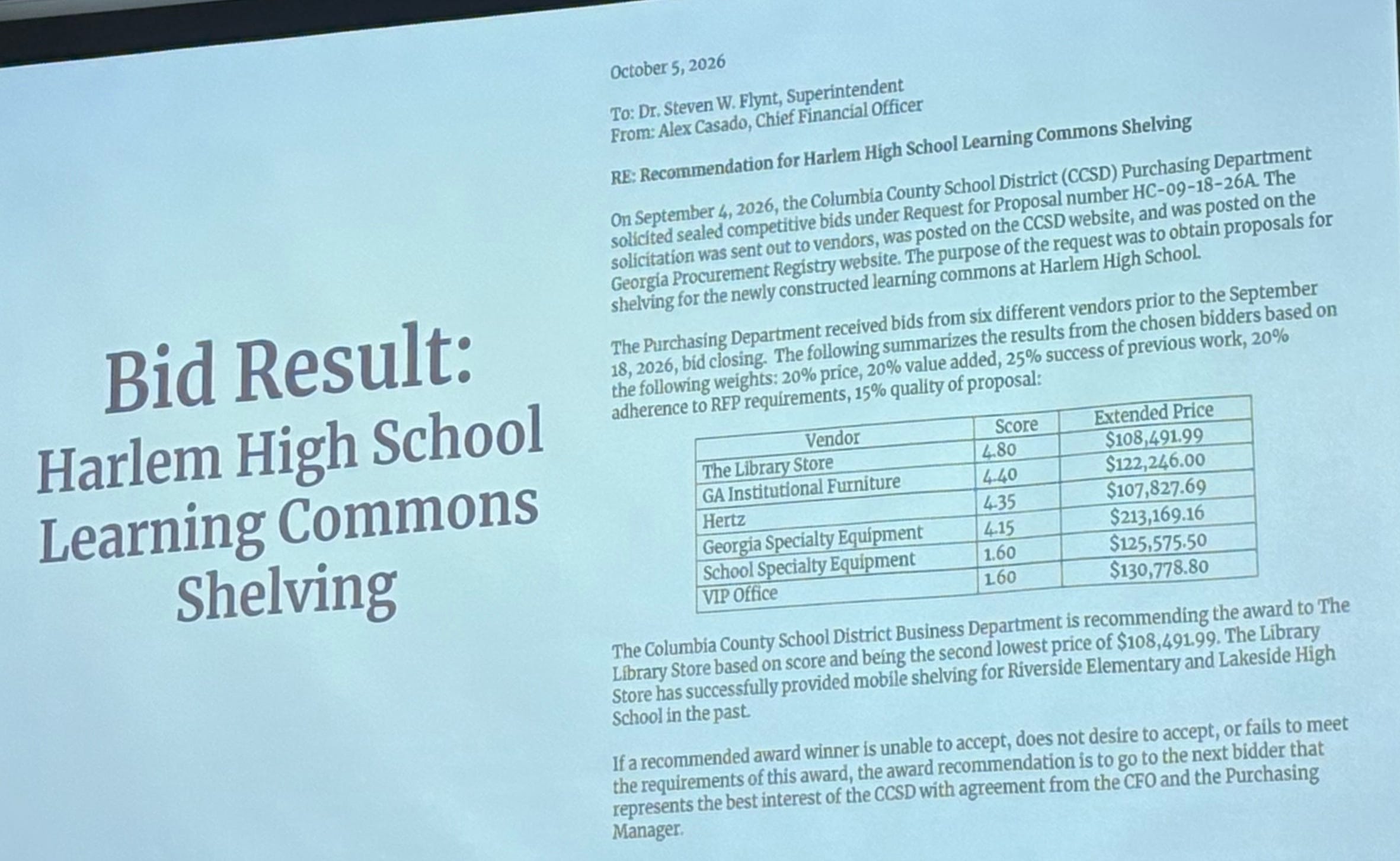
Bid Results. Approve: Yay 5, No 0
Superintendent Reports
SAT Scores
1105
Up 17 points from last year.
74 points above the state average and 94 points above the national average.
Graduation rate for 2026 was 93.75%, the district’s highest since 2011. All five high schools had graduation rates above 90%.
Greenbrier: 95.93%
Evans: 94.15%
Lakeside: 93.47%
Grovetown: 92.92%
Harlem: 91.99%
October is National Principals Month
October 2 as Custodian Appreciation Day
Instructional Coaches Appreciation Day, Georgia Pre-K Week, and National School Lunch Week.
PSAT scheduled for October 14 for eighth- and tenth-grade students.
Report cards also scheduled for October 14.
Columbia County Board of Education received the Georgia School Boards Association’s 2026 Exemplary School Board recognition.
Public Participation: None
Executive Session: Yay 5, No 0. 6:44-7:07 pm
ExecutedAffidavit: Yay 5, No 0
Personnel Sheet: Yay 5, No 0
Adjourn: 7:08 pm