

Call To Order: 5:30 pm
Invocation: West Acres Baptist Church Student Pastor Keaton Neff
Pledge of Allegiance: Grovetown Elementary School 4-H Presidents
Approval of Agenda: (I know it was approved but I got distracted and missed if it was unanimous or if Katie Allen opposed again)
Special Recognitions
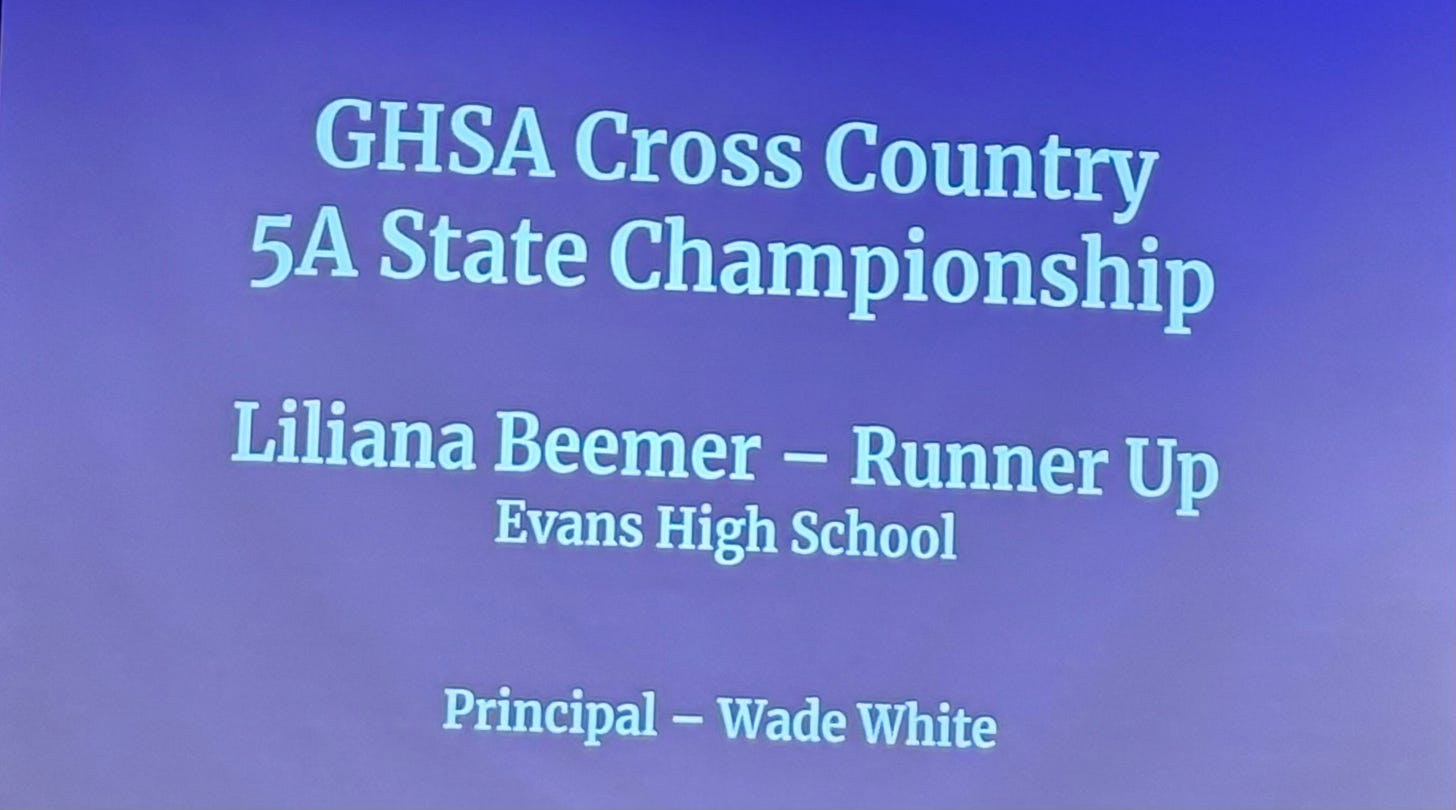
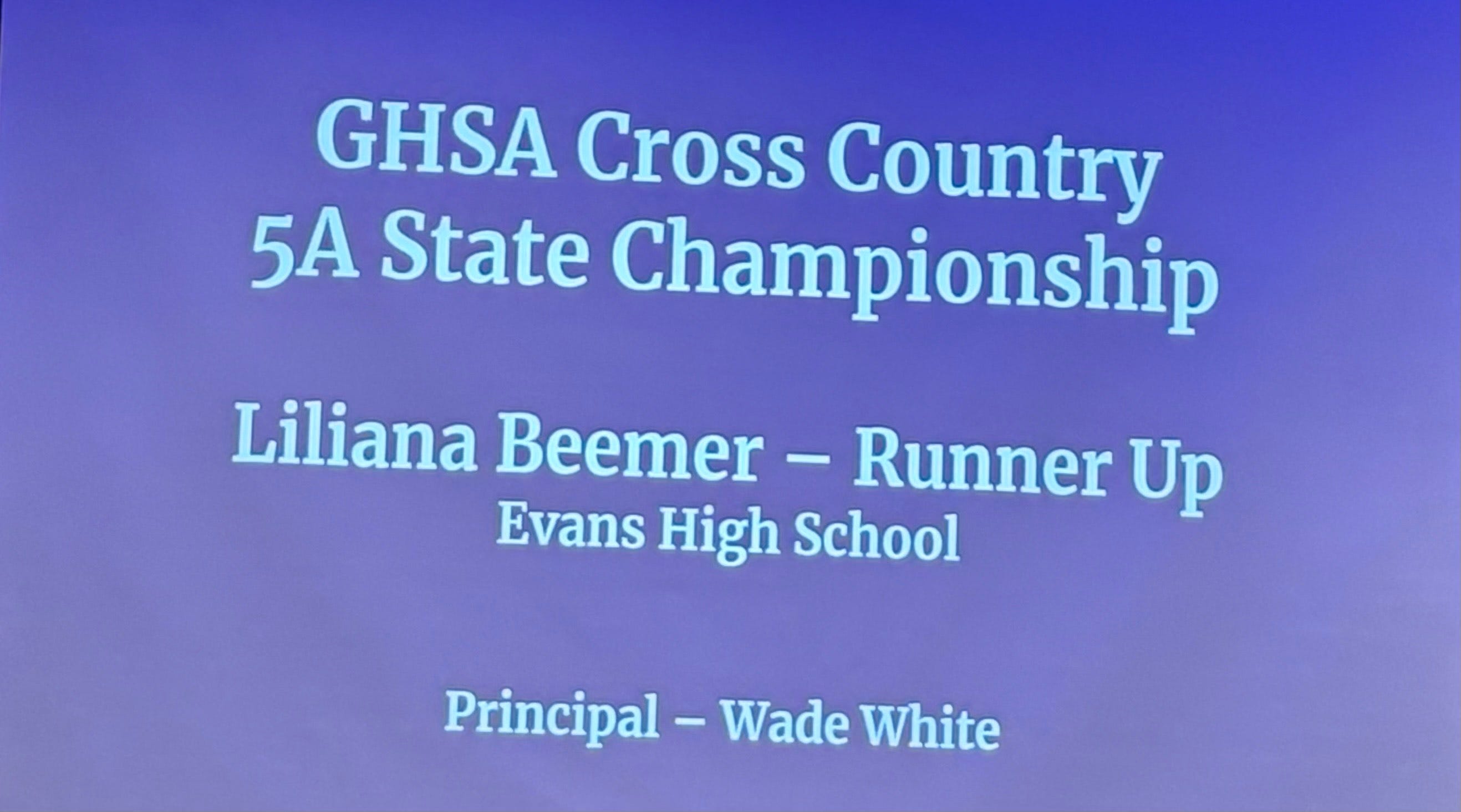
GHSA Cross Country 5A State Championship:
Board Comments:
Kent congratulated Lilliana and thanked the pastor for the invocation.
Teasley thanked the 5th-grade 4H leaders for leading the pledge, expressed appreciation for the invocation, and praised Lilliana Beemer, noting her accomplishments and confidence they’d see her again.
Allen thanked the pastor for the blessing during the invocation and encouraged everyone to keep up the good work.
Baker thanked the 4H leaders and the parents for keeping students involved; wished everyone a Merry Christmas; and asked Lilliana about her training—she reported running about 50 miles per week.
Dekle thanked the school district for assisting with their capstone presentation for the Excellence in Governance program at the retreat
Approval of Consent Items: Yay 5, No 0
11/18/2025 Minutes, Regular Session Meeting
October Financials
Budget Amendment
Fundraisers
Employee Travel
Program/Camp/Employee Participation Request
Lease/use of facilities
Board Policies
Board Policy IF, Instructional Resources. Approval: Yay 5, No 0
Flynt: Added additional language in Paragraphs 2 & 3 for data
Allen: 10 & 11. In 10 it says each parent is provided the policy. Then on 11, it’s by request?
Gregg: #10 refers to the code of conduct. #11 is the whole process for student enforcement, and would be available upon request.
Board Policy KHE, Gifts to Schools. Approval: Yay 5, No 0
Flynt: We added books to the gift policy
Allen: Is there a different policy for gifts in general or something more specific?
Gregg: GBE covers gifts to personnel. This is gift to schools
Building Program
Project updates
Evans High School: Batting cages damaged in hurricane fixed. Other parts of renovation moving along.
Lakeside High School: Steel erected for gym
Ms. Jackson - Student Movement: Renovations to he current commons area and hallway to new science rooms will be renovated starting 12/26/2025 until end of summer. This will make it difficult during transitions to move from PAC side to the other side. They will be transitioning outside. They are looking into a type of temporary separate tunnel but it would be difficult to do and meet all necessary fire/safety code. She will have a bigger update at the beginning of January.
Bid Results
11/18 Asphalt paving Lewiston Elementary School: Approve: Yay 5, No 0
All Star Concrete $324,790
Harlem High School GNP. Approve: Yay 4, No 1 (Katie Allen)
The following exchange is not an exact transcript but it’s close.
Allen: I do have a few points of clarification, as I’m learning this process, so I just ask that the board be patient and not call the question until I work through a few of these things, because I would like to join this vote. Just, again, to clarify as I’m learning about this process: contractors bid on this project in December 2024, is that correct?
Flynt: I have in my board notes that we received proposals from firms in December 2022. They didn’t bid on the cost of the project at that time. What they were doing was giving us information about how they would conduct the construction process, who would be involved, how they would do all that, and then telling us about other projects they were involved in. We had a process to select the firm. Ultimately, in this project, Carroll Daniel was the one that came out with the highest rating, and they were approved in January 2025.
Allen: So, it says, based on the scoring of the committee – and this is from our building program folder, so we all have a copy of this – it says the final ranking of the proposed CMR firms is: Carroll Daniel Construction, Winter Construction, JE Dunn Construction. Interviews were conducted on January 15, 2025. So is this that matrix-based process that we used?
Flynt: Yes, but they’re not bidding on the cost yet. They’re bidding on being the construction firm – the construction manager at risk – to participate as our construction partner.
Allen: So what were some of the factors that were used in that formula to determine the ranking? I mean, was part of that price? Because I know we’ve been told with Turner & Townsend that 30% of that matrix was cost-based, so was cost part of this analysis in choosing Carroll Daniel?
Flynt: Not from them. We provided them our cost estimates, which are obviously moving, and will move until they get all their bids in. But we do our best to try to give the best estimate. They don’t provide the project cost at selection. There’s a lot that goes into that selection. That selection has already been approved and made. Past projects, superintendent qualifications, all of that would be part of their bid to become the firm. So you’re right: we tell them, “Here’s our cost estimate,” but they don’t actually put down a firm cost for what they’re going to do the project for as part of this selection process.
Allen: So you’re saying we tell them, “Hey, here’s our budget,” but they don’t actually put a cost down for what they’re going to do the project for as part of this process. That’s right?
Flynt: That’s right. And it’s not exactly our budget, it’s our initial estimate. We do that so they kind of get an idea of where we are. A big part of this project, and one of the reasons that you go with a construction manager at risk, is to make sure that they’re taking on some of that risk. There are a lot of unknowns. We might not do CMR with a brand-new school that you’re just building out of the ground – we kind of know what to expect there. But you don’t when you’re digging up old infrastructure, and these are pretty old schools.
In this case, once we hire them, they go out and do estimates along the way. That is how we’re able to revise our estimates, because they’re getting subcontractor proposals in. Ultimately, they have to get a bid for every one of those scopes and then put all those together. They have to be vetted by us as well as the project management team. Then we make that decision, we select them, and we sign this document that we approved as a board in January – but that’s not yet the GMP contract with them.
Allen: This was the AIA document A133-2019 between us and Carroll Daniel, dated January 28th. We voted on this at the January 2025 meeting. Just to make sure I understood your email – this is not a contract, then? Because, to me, it looks like a contract. I just want to, again, try to clarify how this process works.
Flynt: I’ll ask Mr. Beatty to step in.
Mr. Beatty: Yes, this is a contract – but it’s the first step. When you start this process, that document – if you look at it – references $80 million in the budget line item. That’s where you start. When this document is signed, unbeknownst to any of us, we don’t even know the full scope of the work. We don’t know exactly what we’re doing long-term as far as what’s going to be torn out, what’s going to be left, what new infrastructure is needed.
Once this is done, we create the set of contract documents and you see the plans. We bring them periodically to the superintendent; you see those, you approve those, we take them to the school, they look at them.
By September, we send those to the State Board of Education for review before final approval. The county reviews, makes comments, it comes back, we make final changes.
At that point in time, they’re submitted to the CMR – the construction management firm. They go through everything, they sit down with us, and when we’re ready, they put this project out to bid.
It comes back line-by-line. When you see these line items – all the trade partners – we open those publicly. We look at the numbers there, they’re vetted, we make sure the low bidders in each category meet all the requirements of the contract documents.
Once that’s done, then – and only then – do you actually have the projected cost of what it’s going to be. That becomes the Guaranteed Maximum Price. In this particular case, that number is $94,900,000-and-change.
What happens next: the next document – the one you have as the amendment – is the GMP amendment to that original AIA contract. Every job that’s ever done in this pipeline follows this type of setup.
So yes, the AIA is a contract for services, and the GMP amendment you’re voting on tonight is what fixes the maximum cost.
Allen: So, I just want to clarify: when we choose our CMR, there’s no number in there other than we tell them our estimate, but they don’t commit to any hard numbers. When we’re “bidding” this CMR, we’re not actually bidding the cost of the project that they commit to do it for. Is that correct?
Beatty: Right. When we’re selecting the CMR, they’re proposing their services – their fee, general conditions, their team, their experience – not a fixed project cost. When we open the trade bids, that’s when the actual construction costs are known. Then their fee is applied and we get the GMP.
Allen: All right. And so when our scope changes, because part of the reason why this went from an $80 million budget to now right under $95 million – about a $15 million, 11% increase from this amendment today versus what was approved in January – the reason for that change is because, apparently, a decision was made to move the athletic fields now behind Harlem High School, because we acquired 25 additional acres. So this project’s scope increased and changed significantly. The price increased 11% now with our budget because of that. So, this is now a big, major change in this project. So now, my point is: whether it’s an estimate or a contract, whether they’re bound by it – given the magnitude and the material change of the scope and the budget – why is this not being re-bid with this new information and current information?
Flynt: There’s a lot there. Hang with me on this one. In August, we had a long retreat where we discussed this number, and the updated number was $105 million. As Mr. Beatty said, along the way we’re going to do our best to get the numbers out there, but sometimes that changes.
As y’all know, the last couple of years we’ve seen a lot of inflation. Now, we may not have seen as much on this one. One of the things that we were able to do – and we approved this with the board – was the purchase of the 25 acres.
Even though that was purchased in October, we didn’t know what the cost of that was going to be, or what the full design might look like, or which field we would have to move. The architect got to work on that sometime in the spring of 2025, and that in itself was probably an $8–9 million addition – but it was a worthwhile addition.
It wasn’t a change order or any of that. It was done before we did the final bid. These estimates are moving, and ultimately, in August, we were talking about $105 million on a CMR that currently came in at just under $94 million, which is excellent. Kudos to the teams that put that together.
Allen: So, we can majorly change the scope of the project, increase the budget by 11%, and continue forward, and that does not change the fundamental bidding situation for the other competitors in any way, even though the scope of the project changed to this magnitude?
Flynt: We believe this is the best firm for this project, based on the criteria we used – not just price, but qualifications, past performance, and their understanding of renovation work on older facilities.
If we went back now, we would have to pay them for the work they’ve done up to now, and then start over. It would just be another cost, and the price would almost certainly be higher the next time we got here.
Dekle: It might be helpful to clear up some confusion by explaining the difference between a CMR process and a straight bid process.
In a straight bid, you have multiple general contractors who give you a firm hard bid, you pick the lowest responsible bidder.
In CMR, you’re hiring a construction manager to do it on a cost-plus basis with a guaranteed maximum price. They do all of the work to get the best bids from trade partners; all of that bidding is then vetted by us. That’s probably one of the reasons we got the number down as low as we did.
The number doesn’t happen until this GMP. That’s the proposal for you to approve tonight.
Allen: This method is problematic, because this isn’t just 11% above right now.
Using this method, for example, with Lakeside High School, we apparently did the same process with a $60 million budget, and then by the time the scope of work was determined and we signed for the GMP, that GMP bumped up to $81 million. That’s a 36% increase. So I’m seeing this pattern where we get a CMR, later decide or change the scope of the work, and then our budget changes. And I’m seeing that that’s problematic, and that history probably contributes, in some way, to why we are currently, as of the 2024 financial report, 96% over the original estimated cost of our ESPLOST in total – where we estimated ESPLOST costs at $160 million, and now our current estimated costs as of that financial report are $313 million.
So when I see that we’re having these overages, and these overages are ballooning, and then I’m listening to our process – “We conduct a bidding process, we select a CMR, but then the scope of work substantially changes and our budget increases 11%, 36% in the case of Lakeside” – something’s got to give. To me, this is not the point of a bidding process.
Baker: In the past, we often heard about change orders. When we bid things out traditionally, we’d get change orders throughout. We never really had a fixed picture – the prices always changed and the cost was kind of fluid when we were building projects, right?
And I foresee that when we do a remodeling versus a new school. Even with a new school we had surprises – like when we hit rock that we didn’t foresee, and it ended up costing more money.
So the cost is somewhat changing at times, correct?
Beatty: There will always be some change orders, but the CMR/GMP structure is meant to limit that. The important thing is we’re updating old buildings that were built under old codes – Harlem and Evans from the late 1970s, for example. Over the years we’ve done a lot of patching, but now we’re doing major modernization, and you don’t completely know what you’ll find until you open up the building.
We’ve been very fortunate that our timing and our community support have allowed us to do these projects. The CMR process is one of the tools that helps protect the district and taxpayers as best as we can in a very volatile construction market.
Allen: When was the discussion to put the athletic fields in a new place? I know you said spring of 2025 – which meeting was that where the board discussed and decided?
Because the scope changed in the spring, and I wasn’t aware of it as a board member. So who made that change and allowed that extra $15 million to the budget? Because it wasn’t us – at least not at a board meeting that I recall. So how did that happen?
Flynt: We had multiple discussions, and the main one – we spent a good bit of time on this at the retreat, talking about this. I’ve sent you the slide. It was a slide we used.
We didn’t take a separate vote specifically on “move fields behind the school,” because it’s part of the overall scope of work within the building program that’s already been approved. If you didn’t want it now, we’d have to go back and essentially start over.
Allen: I guess that still doesn’t answer my question. Who decided that this was the way to go? Because the scope changed in the spring and I wasn’t aware of it as a board member. So who made that change and allowed that extra $15 million to the budget? Because it wasn’t us at a board meeting that I recall.
Flynt: Again, we’ve given multiple updates and the main one was at the retreat. That’s when we walked through the updated scope and cost with the additional acreage.
Kent: I’m just trying to understand what direction you’re going. Are you trying to make the argument that this should be re-bid?
Allen: Ultimately, yes. I think that this needs to be re-bid, given the substantial change in scope of the project that occurred after the CMR was chosen – in fairness to the other competitors in the bid, and in fairness to taxpayer dollars.
When we say, “Here’s our project,” and we have contenders in a bidding process who say, “We can do that scope of work with that budget you’re proposing,” and then we rate them and select one based on an $80 million estimate, and later in the spring the scope substantially changes – new fields, new land, 11% increase – I think that’s substantial enough that it really should go back through the bid process.
Flynt: We believe this is the best firm for this project, based on the criteria we used. The selection process followed the state-approved method. Re-bidding now would cost more and delay the project significantly.
Permissive Transfers:
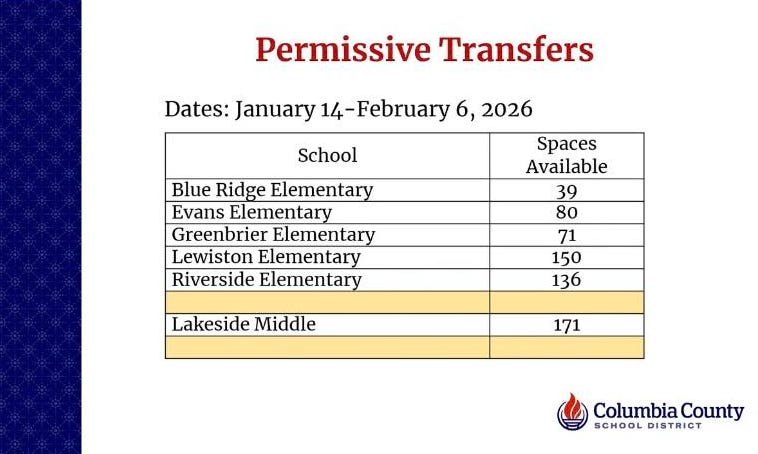
Baker: Does CVA have a cap?
Jackson: Yes. There is an application process. Some seats are left open in case the alternative school needs a spot.
Dekle: How many parents request this?
Jackson: Not that many. I think there were 5 last year at Blue Ridge.
Allen: Is there a specific policy which covers this?
Jackson: Policy JB handles waivers but this is required under law.
Allen asked the board to create a policy around this situation and brought up a specific example of a student’s waiver that was revoked. The parent felt that the district retaliated and without a policy there’s no way to appeal the district’s decision. Chairman Dekle asserted that the parent could bring litigation against the district then if they felt they were wronged, and that is how they could reverse the decision. Judy Teasley asserted that they can’t speak about specific families or students during an open public meeting because of student privacy.
Stop Finder: This is an app that will replace the current transportation app. Will begin rolling it out in mid-January.
Superintendent Reports:
Principal for a Day
10 educators received $500 mini-grants from Columbia County School Foundation
1/8/2026 8th Graders will have Pathway Fair 0900-2pm at Columbia County Exhibition Center
Early Dismissal: 12/19/2025
Winter Break: 12/22/2025-1/1/2026
1/2/2026: Teacher Workday/ Student Holiday
1/5/2026: First day of 2nd Semester
1/9/2026: Report Cards
Public Comment:
Christine Floyd
Joan Krupsky
Karin Parham
Cara Parker
Brenda Heideman
Janet Duggan
Harlem VFW
Executive Session: None
Personnel Recommendations. Approve: Yay 5, No 0
Adjourn: Approve: Yay 5, No 0
Next Regular session board meeting 1/13/2026.
Certainly appears Allen needs to do more homework before coming to a Board meeting. Maybe she needs to get an appointment with Flynt the day before the meeting so she can get her endless questions answered by staff.