

by Karin Parham
During a recent appearance on The Austin Rhodes Show, Columbia County Commission Chair candidates Alison Couch and Cambrey Wood described very different feedback from residents about data center development.
Couch said she heard from residents excited about anticipated tax revenue and property tax relief. Wood described hearing concerns about whether the potential benefits were worth the trade-offs. Both statements can be true. Someone can welcome the possibility of property tax relief while questioning where data centers are being built or how the projects were approved.
After hearing that discussion, I wanted to know more about what residents actually thought, beyond simply supporting or opposing data centers. I conducted a survey through The Columbia County Observer asking about property tax relief, future projects, and community concerns.
This was a voluntary, anonymous community survey, not a scientific poll. It was shared through the Observer’s Facebook page and Substack. Participation was self-selected, and the results should not be interpreted as representative of Columbia County residents as a whole. Residents with strong opinions may have been more likely to participate.
Participants were asked to complete the survey only once. I chose not to collect names or email addresses to preserve anonymity, which also meant there was no way to verify that each submission came from a different person.
I identified an unusual pattern among 37 submissions received on October 27, the final day of the survey. Those submissions reversed which position led on general support for data center development, so I included charts of the data both with and without them.
What the Numbers Show
The survey asked whether respondents generally supported data center development in Columbia County and whether they supported approving additional projects beyond those already approved at White Oak and Pumpkin Center.
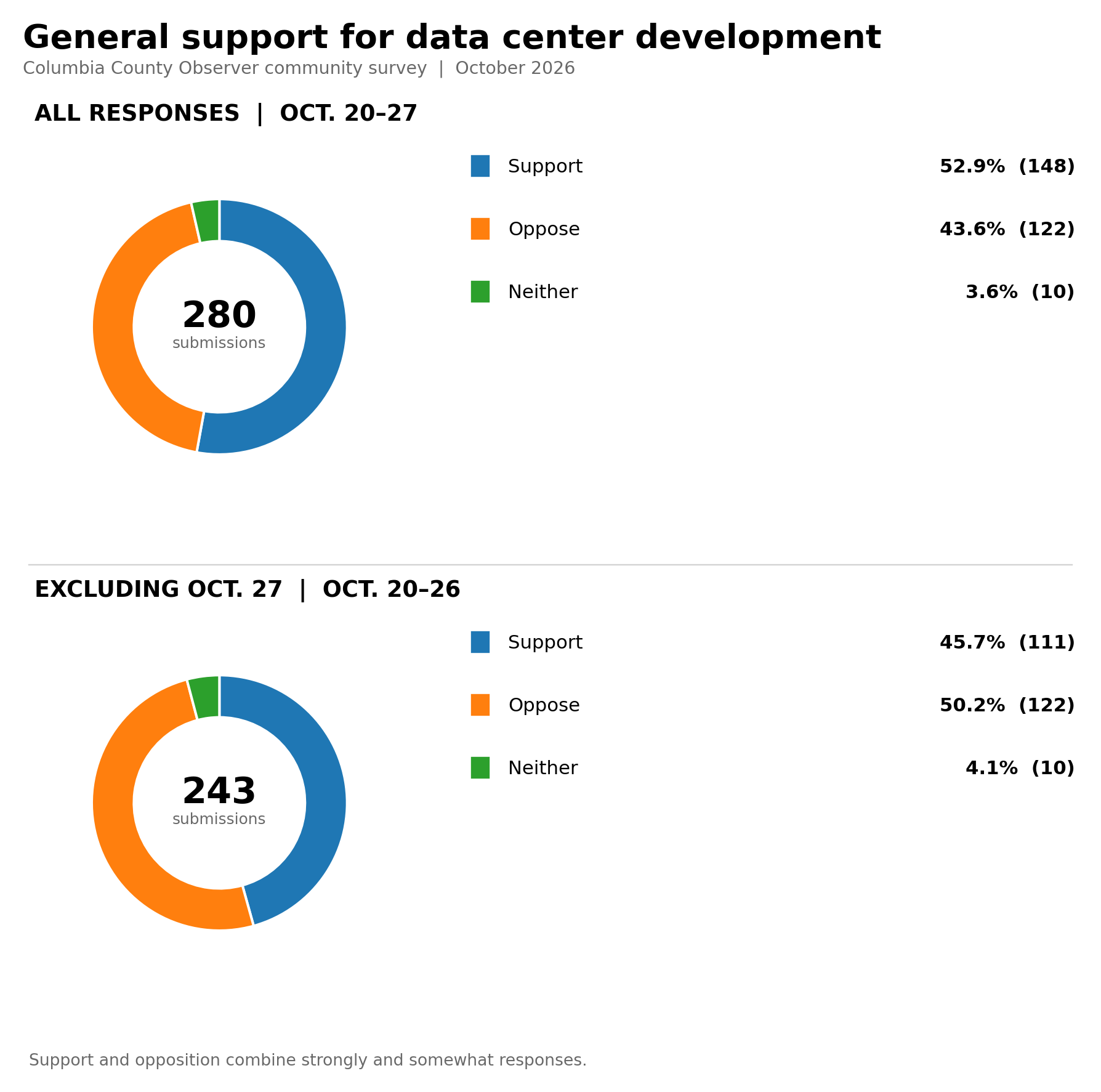
With all 280 submissions included, 52.9% generally supported development, compared with 43.6% opposed. Excluding October 27 changes the results, with 50.2% opposed and 45.7% supportive.
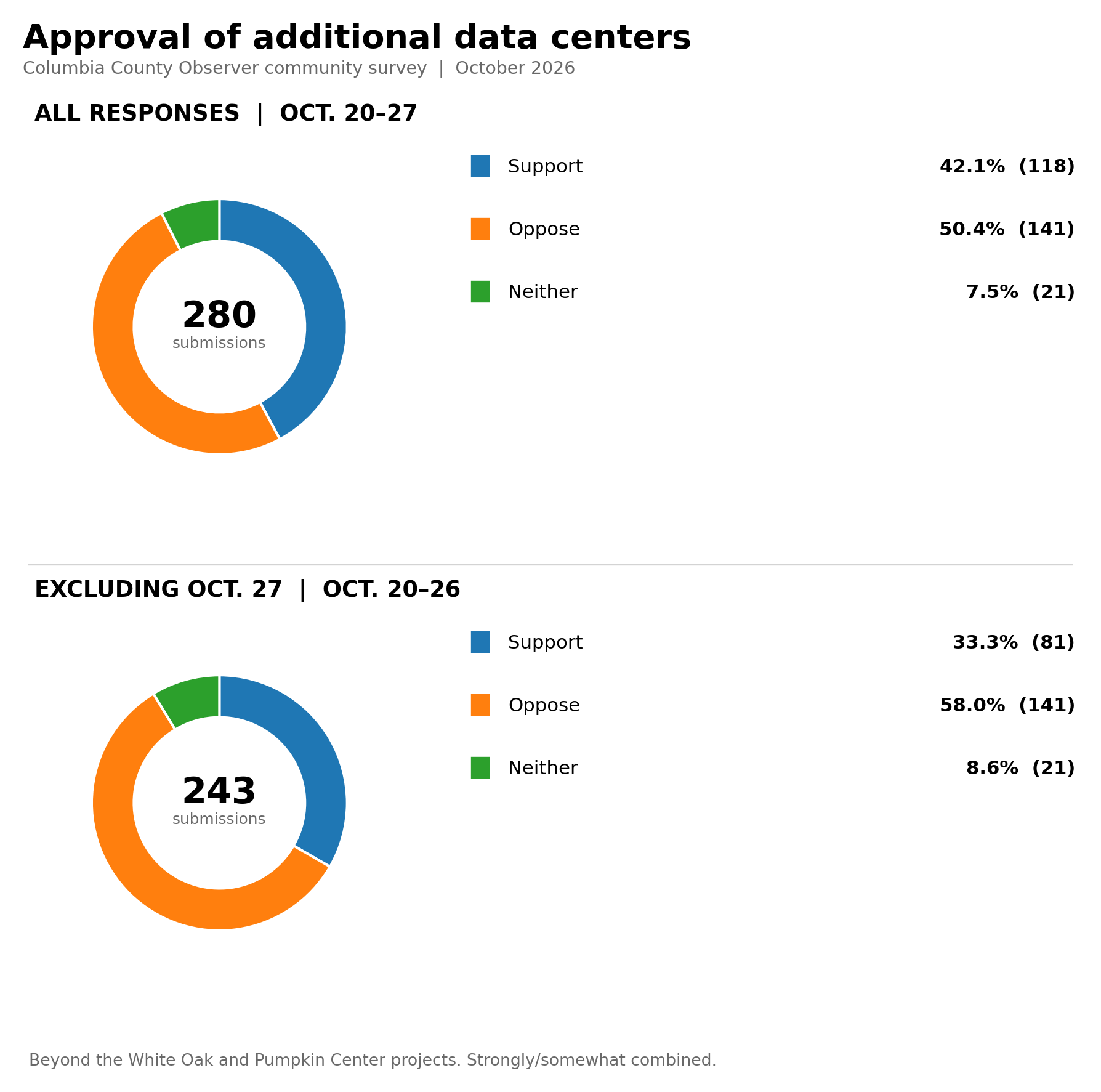
Opposition to approving additional data centers exceeded support in both sets of results. Among the 243 earlier respondents, 58% opposed additional projects, including 53.5% who strongly opposed them.
Some respondents who generally supported development were less enthusiastic about further expansion. Of the 111 generally supportive respondents before October 27, 13 opposed additional projects, and another 18 neither supported nor opposed them.
Property Tax Relief
Expectations of property tax relief were closely associated with opinions about development.
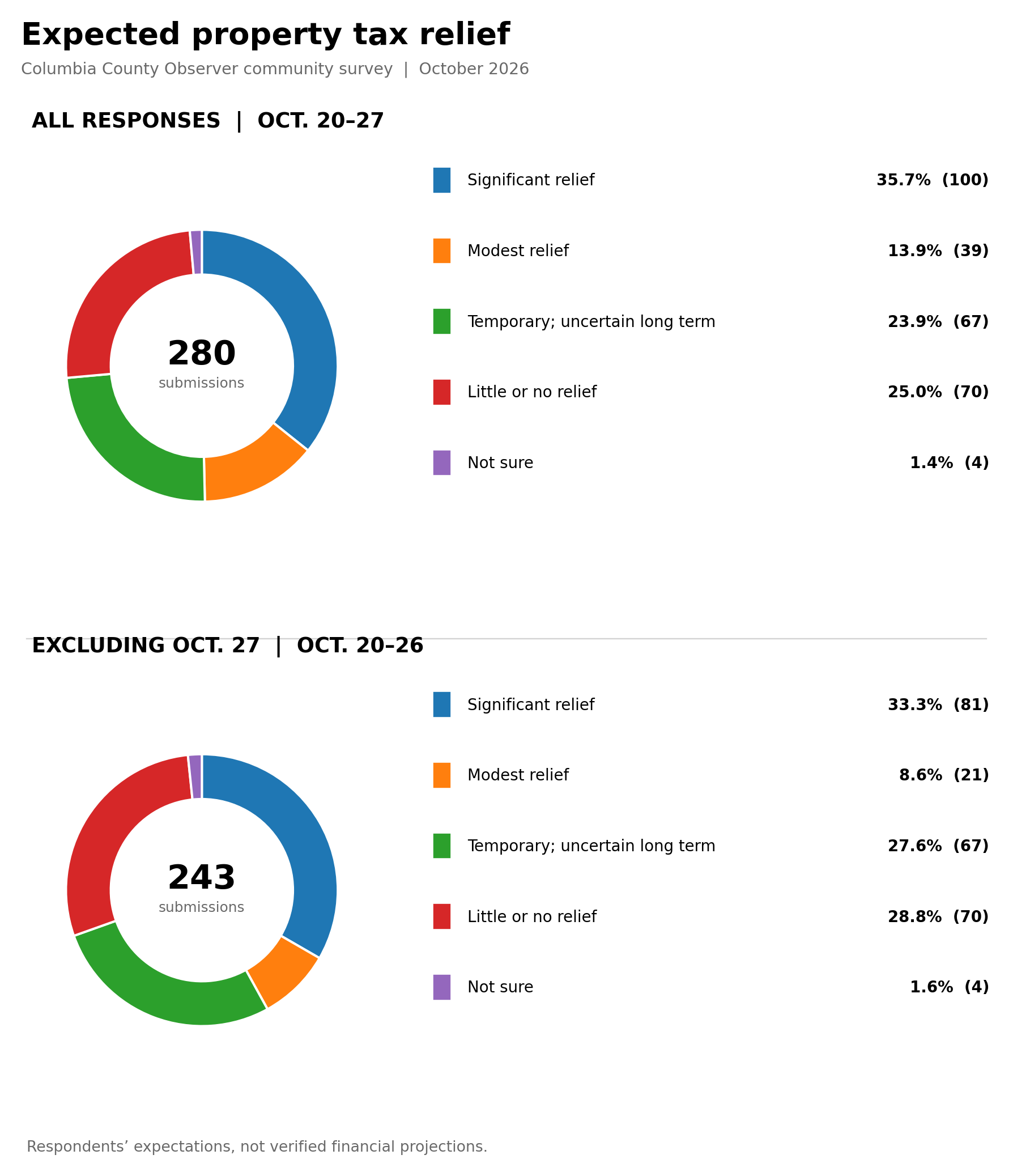
Among the 243 earlier submissions, 81 respondents expected significant property tax relief, and all 81 generally supported development. Conversely, 67 of the 70 respondents expecting little or no relief opposed development. Another 67 anticipated temporary relief with uncertain long-term benefits, including 51 who opposed development. Of the remaining 25, 21 expected modest relief and four were unsure.
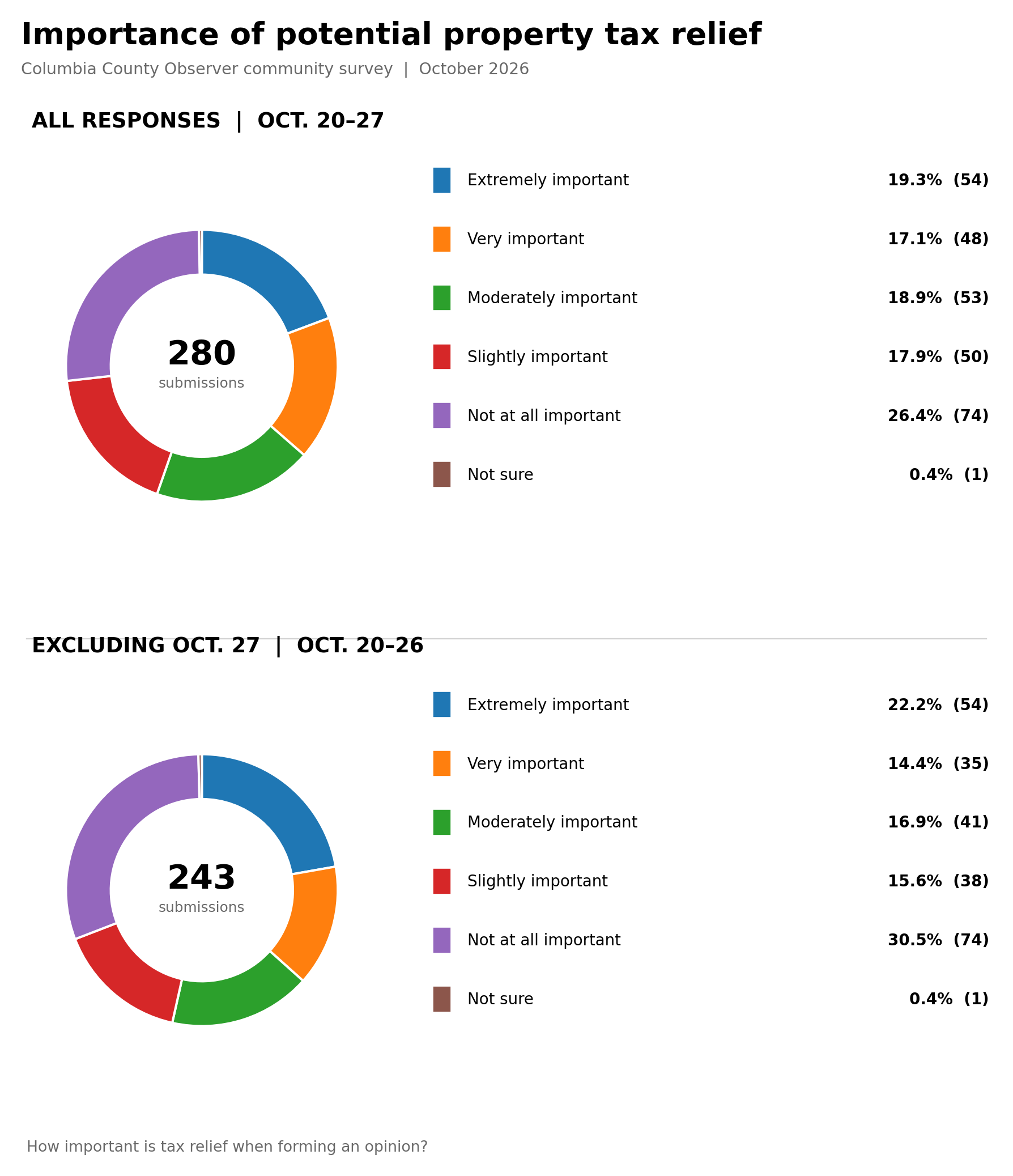
Among the 243 earlier submissions, 30.5% said potential property tax relief was not at all important when forming their opinions about data center development. Another 22.2% said it was extremely important, and 14.4% considered it very important. The remaining respondents were divided among moderately important (16.9%), slightly important (15.6%), and unsure (0.4%).
Community Concerns
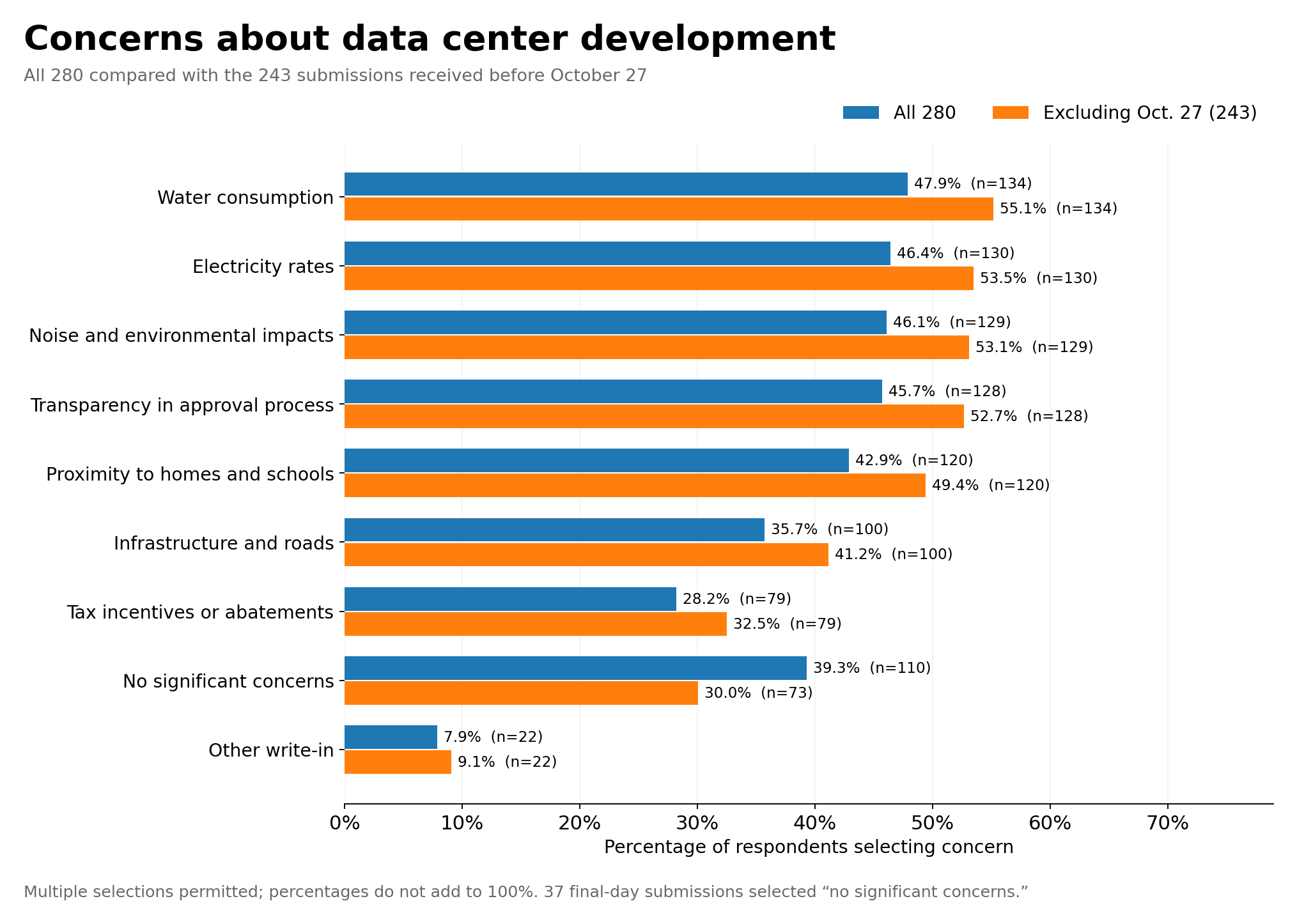
Water consumption, electricity rates, noise and environmental impacts, and transparency in the approval process were the most frequently selected concerns. Respondents could select multiple concerns, so the percentages do not add up to 100%. Excluding October 27, 55.1% identified water consumption, 53.5% electricity rates, 53.1% noise and environmental impacts, and 52.7% transparency.
The survey also received 108 written comments. Supporters frequently emphasized property tax relief, economic development, and the potential advantages of commercial development over continued residential growth.
One Appling respondent wrote, “These data centers will allow me to stay in my home in Appling as I age.”
Opponents raised concerns about environmental impacts, property values, utility costs, and the approval process. Some respondents supported data centers generally but opposed their placement near residential neighborhoods or wanted future developments restricted to industrial areas. One respondent wrote, “Data Centers should be limited to Industrial Parks.”
Others questioned what would happen if the facilities eventually became obsolete, including who would pay for demolition or environmental restoration.
Transparency was another recurring theme, including among supporters. Respondents questioned nondisclosure agreements, public involvement, and the availability of information about the developments.
Who Responded?
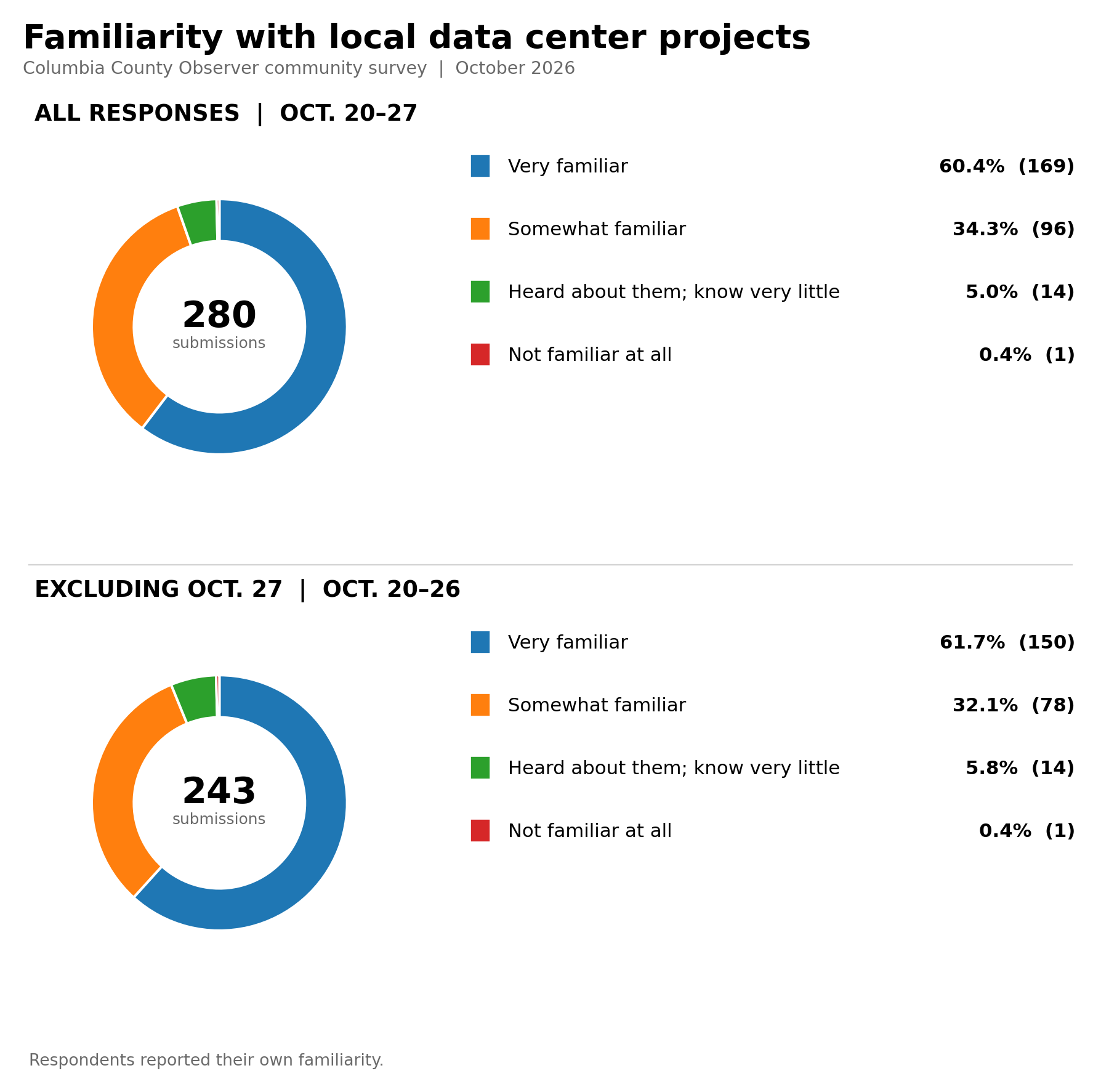
Most respondents considered themselves familiar with Columbia County’s data center projects. Among the 243 earlier submissions, 150 reported being very familiar, and another 78 were somewhat familiar.
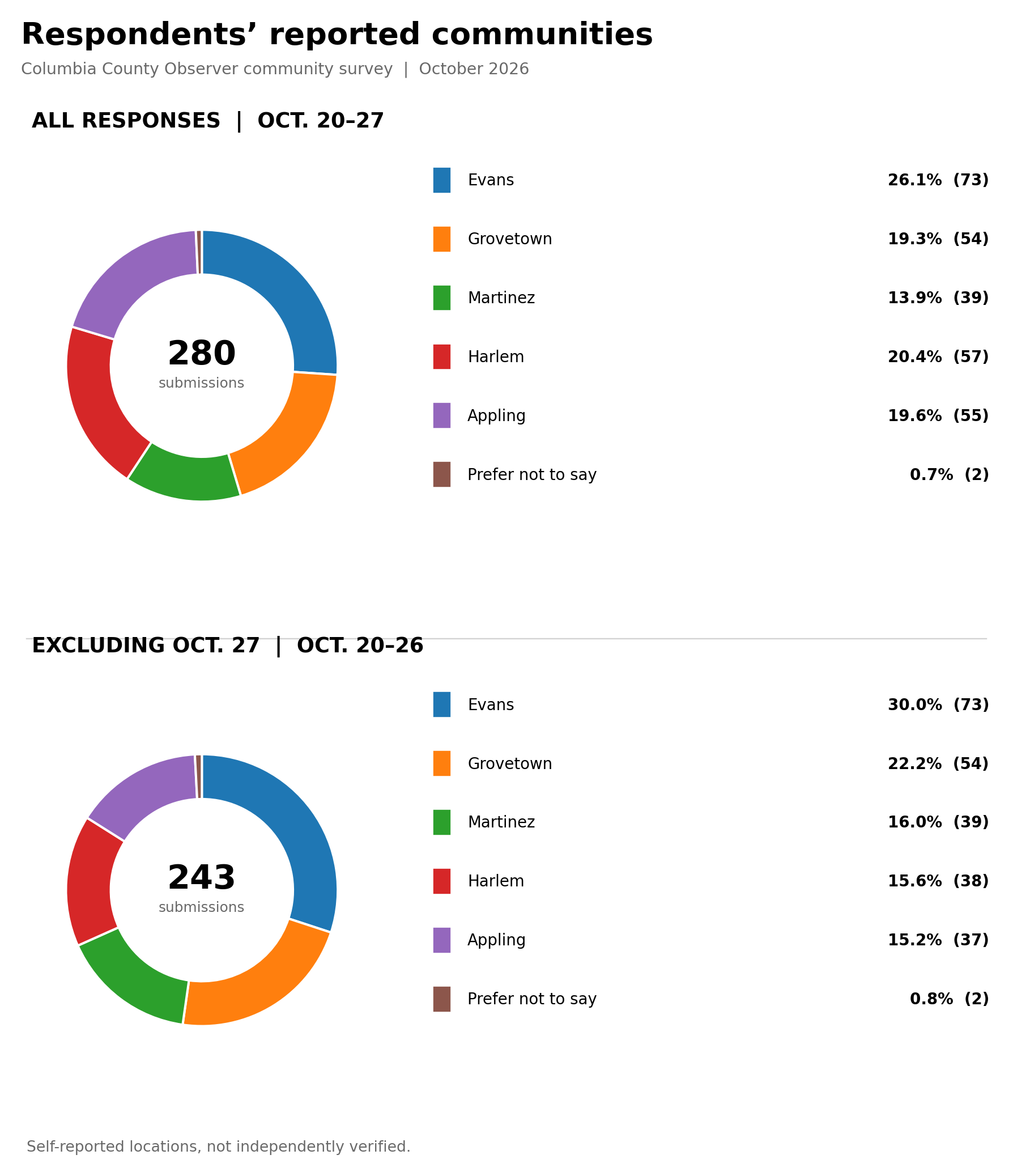
All 280 respondents identified themselves as Columbia County residents, although residency was not independently verified. Excluding October 27, Evans accounted for the largest number of submissions, followed by Grovetown, Martinez, Harlem, and Appling. The October 27 submissions, which made up about a third of all responses from Harlem and Appling, moved those two communities from fourth and fifth to second and third. Two respondents did not identify their community.
What Happened on October 27?
Participation declined substantially after the survey’s initial launch. I did not repost, boost, or otherwise promote the survey after October 20.
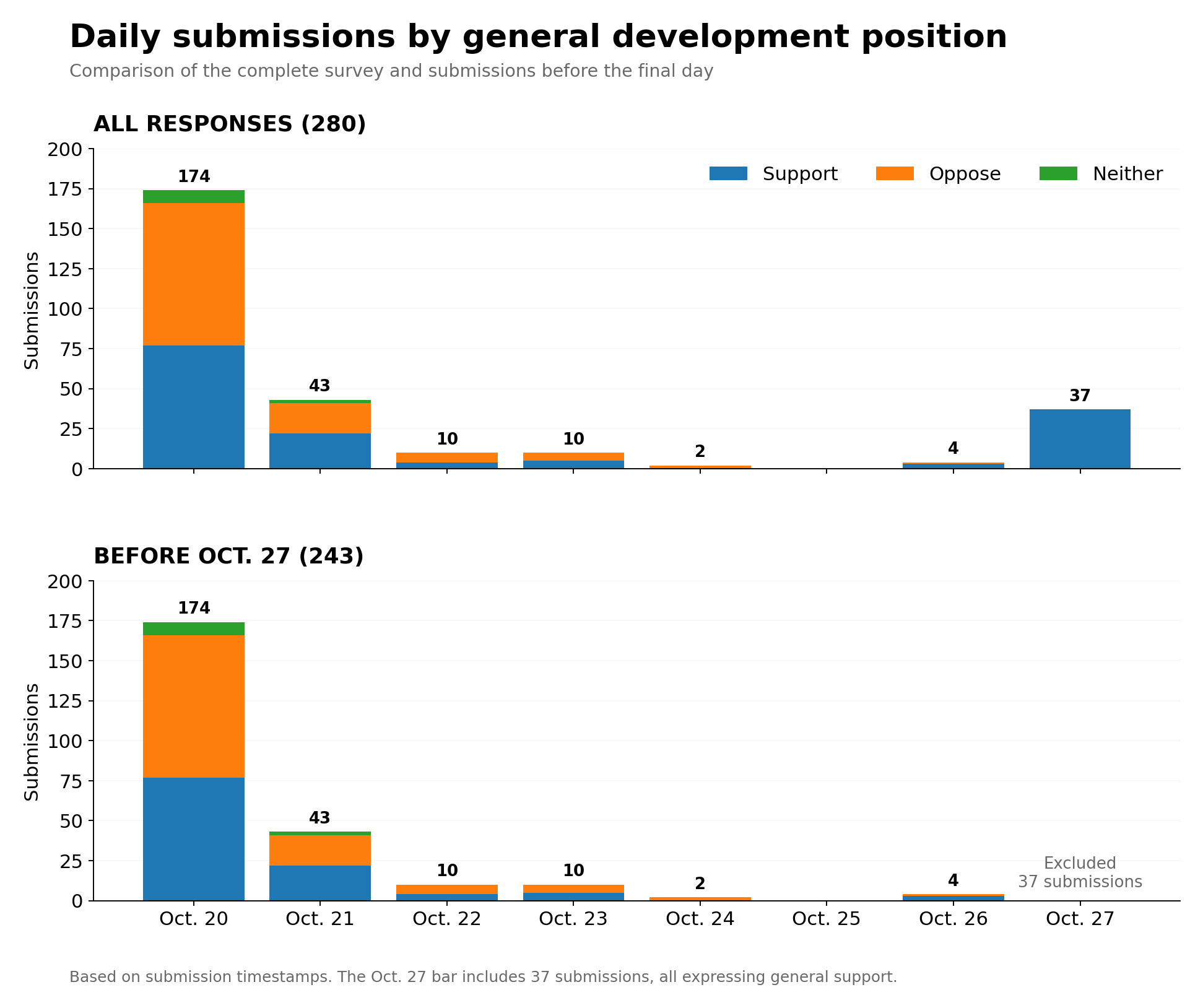
The survey opened on October 20, and that first day produced 174 responses, with 77 supporting development, 89 opposing it, and eight neither supporting nor opposing it. The following day produced another 43 responses, again reflecting mixed opinions. Another 22 arrived between October 22 and October 24.
Only four submissions were received on October 26, with none on October 25.
Then, on October 27, 37 submissions arrived between 6:01 a.m. and 11:55 a.m., just minutes before the advertised noon deadline. Every one of those submissions supported data center development generally and additional data center projects.
A closer look revealed several other similarities:
All 37 reported no significant concerns.
All identified either Appling or Harlem, with 18 selecting Appling and 19 selecting Harlem.
Of the 36 transitions between consecutive submissions, 32 switched between Appling and Harlem, almost exactly back and forth in an A-H-A-H pattern.
Nineteen strongly supported general development, while 18 somewhat supported it. Those answers also alternated, switching between strongly and somewhat in 34 of the 36 transitions.
Nineteen expected significant property tax relief, while 18 expected modest relief.
None provided written comments.
The timing was also unusually consistent. Submissions arrived approximately 6-13 minutes apart, with an average interval of 10 minutes.
A further review found that three of the four October 26 submissions, which arrived between 10:24 and 10:35 p.m., shared similar characteristics: supportive answers, alternating Appling and Harlem locations, no significant concerns, and no written comments. Those three remain in the 243-response comparison because the comparison excludes October 27 only.
The October 27 responses also changed the geographic results. General support among respondents identifying Harlem increased from 44.7% to 63.2%, while support among those identifying Appling increased from 45.9% to 63.6%.
Earlier submissions reflected a mixture of opinions, concerns, and locations. The final 37 did not. I may have been too optimistic in relying on the honor system to ensure people responded only once. Given the remarkably consistent timing, alternating locations, and repetitive answer patterns, I suspect someone was submitting multiple responses to influence the survey results. I can’t prove that from the available data, but I find it difficult to believe these were 37 independent residents responding at regular intervals throughout the morning.
For transparency, I included both sets of results rather than removing the submissions or overlooking the discrepancies. Neither set is a representative sample, and I cannot verify that the earlier submissions came from different individuals either. I’m not sure why anyone is that concerned with a local unscientific straw poll, but here we are.
Back to Couch and Wood
Couch and Wood described hearing very different things from residents. I don’t think their statements necessarily contradict each other, though.
We tend to lose sight of how varied opinions are when a controversial issue is reduced to two opposing sides. People can recognize the benefits of something while also having concerns about it. Most issues are more complicated than a simple yes-or-no question. That’s easy to forget in an era of 15-second sound bites and snap judgments, but it’s worth keeping in mind.
I met a man Tuesday who has twice contacted the development authority exec, seeking details of both tax abatement extended during negotiating this deal, and attested property tax relief to homeowners. He is absolutely devastated that no one has responded.